Note: This was originally published in the Stickneys of Texas newsletter Fall 2013.
Jesse Fearson was Edward Lawrence Stickney’s maternal grandfather and probably a big influence on his decision to go to Texas and help liberate it from Mexico. As family legend goes, E. Lawrence was from Mobile, Alabama, but was pursuing a law career in Baltimore before coming to Texas. It is suspected that he may have come to Texas on a privateer, since under remarks for qualifying for a second-class headright was stated “at a Cannon on Sea”. Growing up, E. Lawrence would have listened to tales from his grandfather of privateering and how to man a cannon would have been an important part of the stories.
Jesse Fearson’s early life is not well known, but he must have grown up along the coast navigating waterways most of his life to gain experience to captain a vessel in his twenties. It is not until 1779 that we first find evidence of Jesse’s participation in the American Revolution, but he must have been active prior to this to be chosen to command. Jesse Fearson’s first known commission was petitioned for on Aug. 18, 1779, by Edward Norris to the Salem council requesting Jesse Fearson be commander of the schooner Swett. The commission was issued the next day. A schooner is a vessel with two or more masts, with fore and aft sails on both masts, normally less than 150 tons. Again, in Salem on April 27, 1780, Miles Greenwood of Salem, along with the other owners of the brigantine Fortune, fitted for a three-month cruise, requested Fearson be commissioned as commander. It was granted by the council on the same day. A brigantine is similar to a schooner, has two or more masts, each with fore and aft sails, but normally with the tonnage range of 150 to 250 tons. May 23, 1781, Samuel Page on behalf of himself and others petitioned the Salem council requesting Jesse Farson [sic] be commissioned as commander of the brigantine Cato (privateer); age 28 years, stature 6 ft. complexion light. The commission was issued the same day. A few days later, on May 28, 1781 a $20,000 bond was filed on this 16 guns and 60 crew Massachusetts vessel. Jesse Fearson is listed as Master, as well as one of the bonders, along with Bartholomew Putnam of Salem and Stephen Bruce of Boston. Owners are listed as Samuel Page and others of Salem. Witnesses to this bond are James Fosdick and John M. Lovell.
March 27, 1782, Job Prince on behalf of Andrew Cabot and others, of Beverly, Massachusetts ask that Fearson be commissioned as commander of the ship Buccanier (privateer) and it was granted the same day. Also, on the same day a $20,000 bond was posted for this Massachusetts ship of 18 guns and 120 crewmen. Jesse Fearson is listed as shipmaster again as well as one of the bonders, stating he is of Boston, along with Andrew Cabot and Job Prince, Jr. of Boston. Owners are listed as John and Andrew Cabot of Beverly and the witnesses are Isaac Peirce and John Dall.
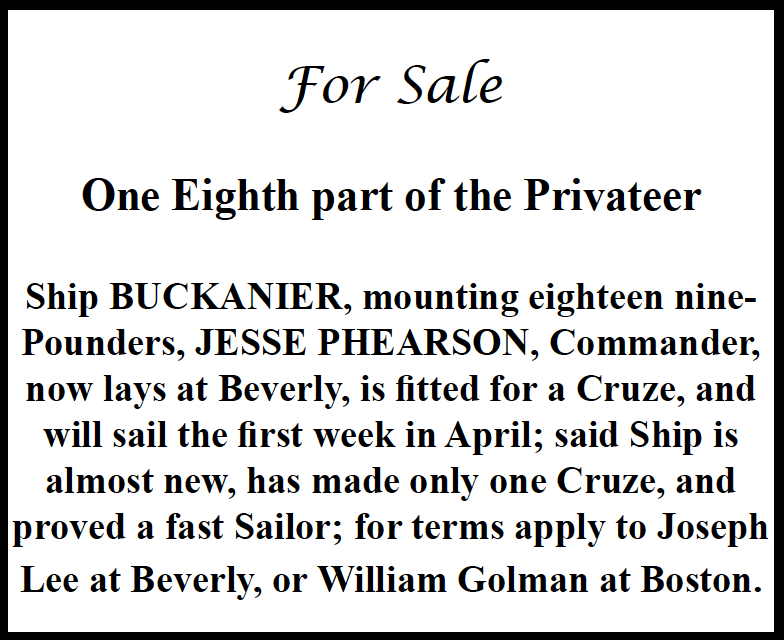
Privateering was a profitable high stakes enterprise, as well as dangerous warfare. If captured, Jesse Fearson risked confinement in an English Prison since England viewed privateers as common pirates and not prisoners of war that were often traded between the two warring countries. So how did Jesse Fearson profit as a ship’s captain? On privateers the sailors hired on for a certain cut of the prize uncertain if they would make a capture or possibly be seized themselves. The owners of the ship got the first cut off the top and that could be anywhere from two-fifths to two-thirds of the take. The men that actually sailed on the vessel got varying shares of what was left accorded by their rank with the ship master getting the highest number of shares. An ad found in the Continental Journal newspaper, dated 4-18-1782, illustrates how a shareholder wanted to sell his one eighth share of Jesse’s privateer, (see inset).
From History and Genealogy of the Cabot Family, 1475- 1927, by L. V. Briggs, an inventory of a prize seized and brought into Nantes, France by Capt. Jesse Fearson when he commanded the Buccanier is noted. Now the Buccanier was classified as a “ship” which meant it had three or more masts with square sails on each and could exceed 500 tons. The ship he seized was a Brig named Kitty. A “Brig” was a two mast vessel, square rigged on both masts usually between 150 and 200 tons. Thus, the Buccanier had more sails, which made it faster, and it was larger, so it carried more canons than the Kitty. The first thing listed on the inventory is “The Brig & appurtenances £4,200.” Appurtenances are all the trimmings: sails, ropes, etc., but may not include the anchor because two anchors are listed next along with their fathoms of cable. The anchors and cable and “Caboose for 12 Men” had a listed value of £1231.5. So basically, all that Capt. Fearson brought into the port of Nantes, France was the Brig. The inventory continues to list the cargo that was found on the Kitty, but that was sold elsewhere or at least prior to being presented to the agent for clearance. The total value of the inventory was £60,622.18. The agent in charge takes a five percent cut off the top along with any expenses incurred during the process such as unloading and storage fees. This amounted to £7,501 bringing the total to £53,121.18 which was evenly split half to the owners and half to the crew. How the crew’s half was divided up is not known, but Jesse Fearson as ship master would have gotten the largest take probably five times as much as a regular crewman. It is interesting to note that this inventory was signed by Jonathan Williams who was in Nantes, France at the request of his uncle, Benjamin Franklin to oversee any Continental receipts and was known to keep impeccable records at the time.
While Captain Fearson was out sailing the high seas, he had a family waiting for his return. Eight months prior to his first recorded commission in 1779, he married Elizabeth Welman. Evidently his third known commission on the Cato, was profitable enough for him to purchase on November 12, 1781 a plot of land with a house and barn from a Mr. Paul Dudley Sargent Esq., for two thousand pounds. This was more than six times the amount Mr. Sargent paid for it a year earlier on September 16, 1780, that being three hundred pounds sterling. The record states that Jesse Fearson is a merchant of Salem and a map of the property indicates a house facing “The Main Street”, affording him a place to market his goods from his voyages. He held this property for almost two years before selling it on September 17, 1783 to William Grey III of Salem, “a famous merchant”, at a loss for one thousand and three pounds. This is the last detail I have thus far in Jesse Fearson’s life in the Salem, Massachusetts area and must speculate that the selling of this property might indicate his movement out of this area.
Jesse’s wife Elizabeth Welman died December 28, 1787 and I know they had at least one child, Mary Wellman Fearson born June 4, 1786, and that Jesse and his daughter, Mary, relocated by the 1790s to Baltimore, whether it was before or after wife Elizabeth’s death is not known. May 28, 1791, Jesse Fearson marries Hannah Young, it is the second marriage for both and each bringing at least one daughter into this new marriage.






 Forwardly Looking Back