Cephas H. and Annie O. (Stickney) Brown Family Bible
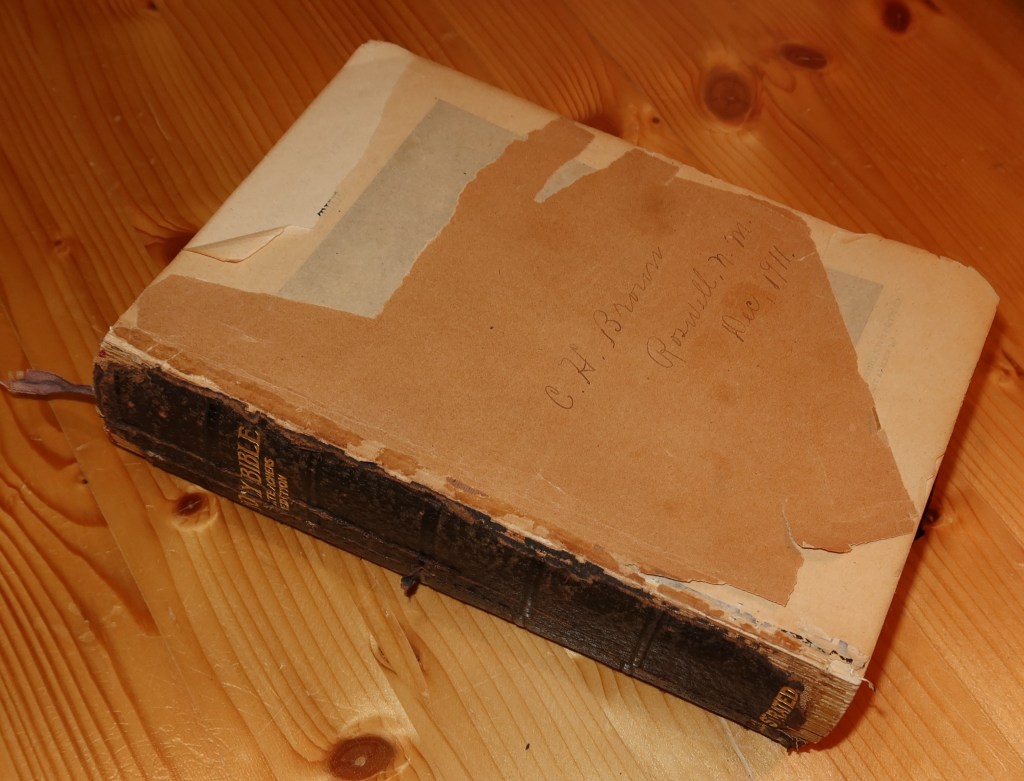
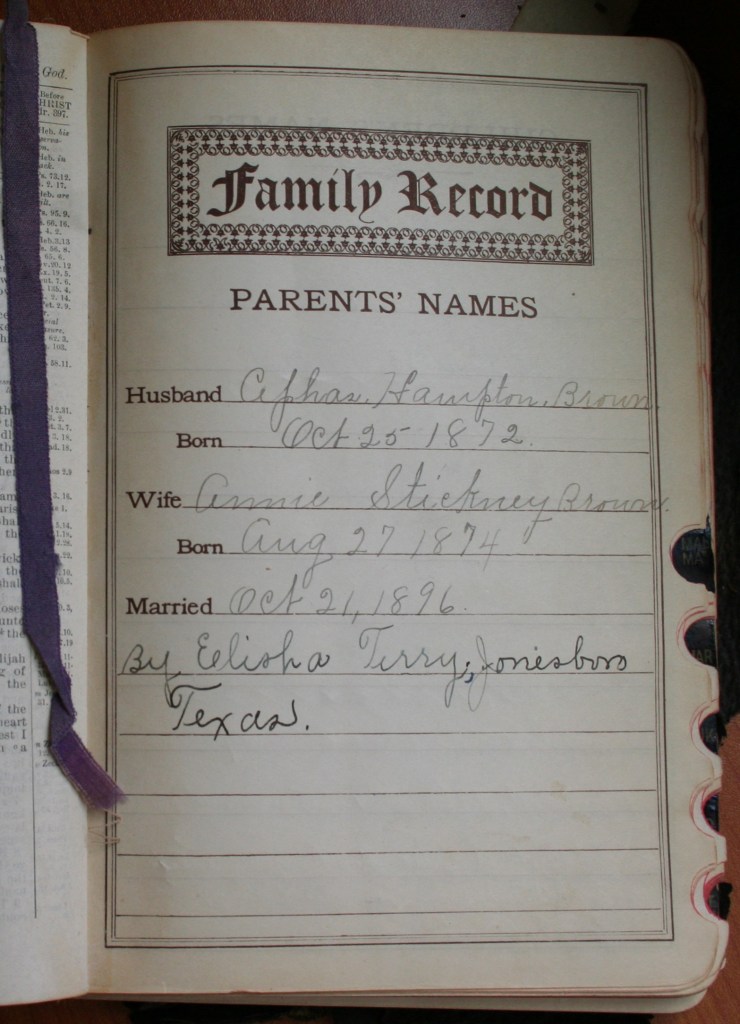
This Bible appears to have been well used. The front cover is missing, and only three threads are holding it together across the spine. “Holy Bible, S.S. Teachers Edition” is printed in gold type on the intact, but split spine. Written in faded ink on the tattered tan-colored liner page is “C. H. Brown, Roswell, N.M., Dec, 1911.” The title page has no date as to when it was printed, nor could I find a date anywhere else in this Bible. The printer, Blackwell-Wielandy Book & Stationery Company was founded in 1896 in St. Louis, Missouri. This Bible holds the following family records on this Roswell, New Mexico family.
Unusual to most bible records, under “Deaths,” the writers thought it important to enter the related facilities where the deaths occurred and the attending physicians.
This Bible is currently in the possession of Deborah Allard in Kingsland, TX. txallard@gmail.com
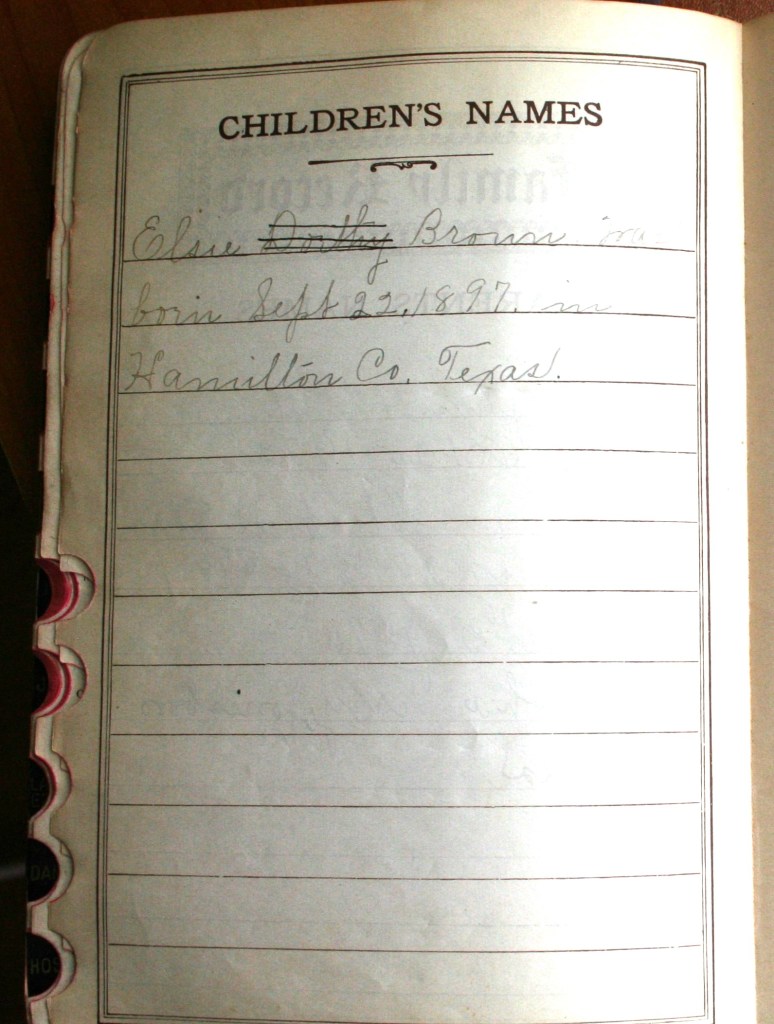
Elsie Brown was born on September 22, 1897, in Hamilton, Texas, according to her delayed birth certificate, dated April 1, 1942. The family Bible records her name as Elsie Dorthy Brown, but the middle name “Dorthy” is marked through with three black lines. There is no middle name on her delayed birth certificate, but her University of Texas record lists her as “Elsie Walton Brown.” Her delayed birth certificate required statements from two individuals with knowledge of her birth: her mother, Annie Brown of Chaves County, New Mexico, provided one affidavit, and the other was provided by Mrs. Carter Walton, who is identified on Ancestry records as Susan Elsie (Bledsoe) Walton of Hamilton County, Texas. It is unclear how Mrs. Carter Walton is related to the Brown Family; she may have been a family friend present at Elsie Brown’s birth and perhaps Annie had told Elsie she was named after this person. Elsie’s decision to use “Walton” as her middle name on her University of Texas record may have been to distinguish herself from other Elsie Browns. However, in most records and documents, she is simply referred to as “Elsie Brown.”
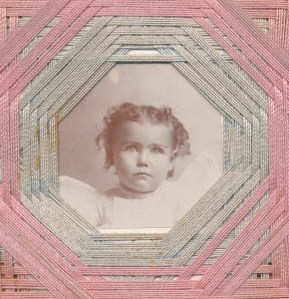
Elsie Brown ~ 1904
Not much is known about Elsie’s childhood in Roswell, New Mexico, as the only child of Cephas Hampton and Annie Oleana (Stickney) Brown. It seems that as a young adult, she was well accomplished academically. Below is a list she created of the schools she attended and where she taught or was a school librarian.
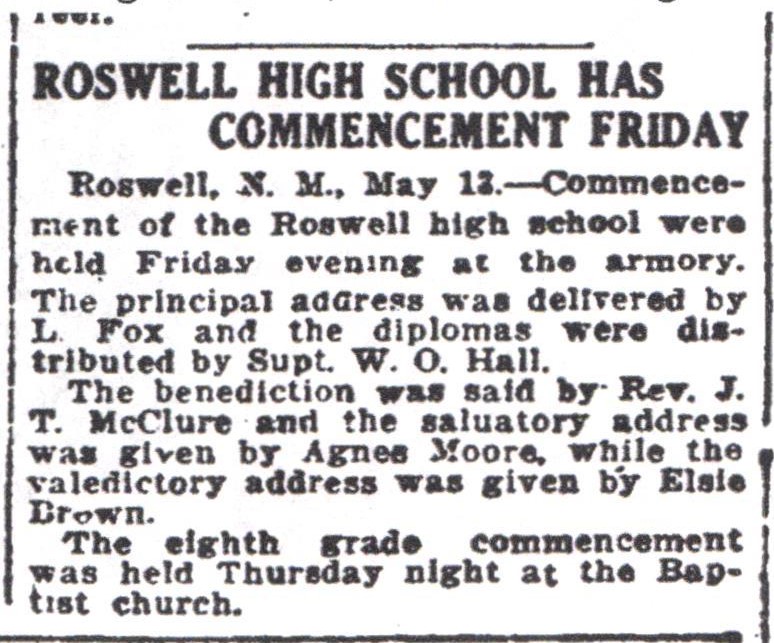
Elsie Brown graduated from Roswell High School in 1916, a year after her aunt, Clydine Stickney, graduated top of her class at Midland High School in Midland, Texas. Unlike Clydine’s personal papers, where her high school diploma and commencement program listing the graduates were found, there were no items in Elsie’s papers regarding her high school graduation, but the following article was found.
El Paso Herald (El Paso, TX), Saturday, May 13, 1916, GenealogyBank.com
Elsie did match her aunt’s accomplishments of graduating at the top of her high school class, which other newspaper articles stated consisted of fifty-three students. Unlike Clydine, Elsie didn’t have to support herself and was able to continue her upper-level education after high school. It took Clydine eleven years before she completed her degree at the University of Texas in 1926.
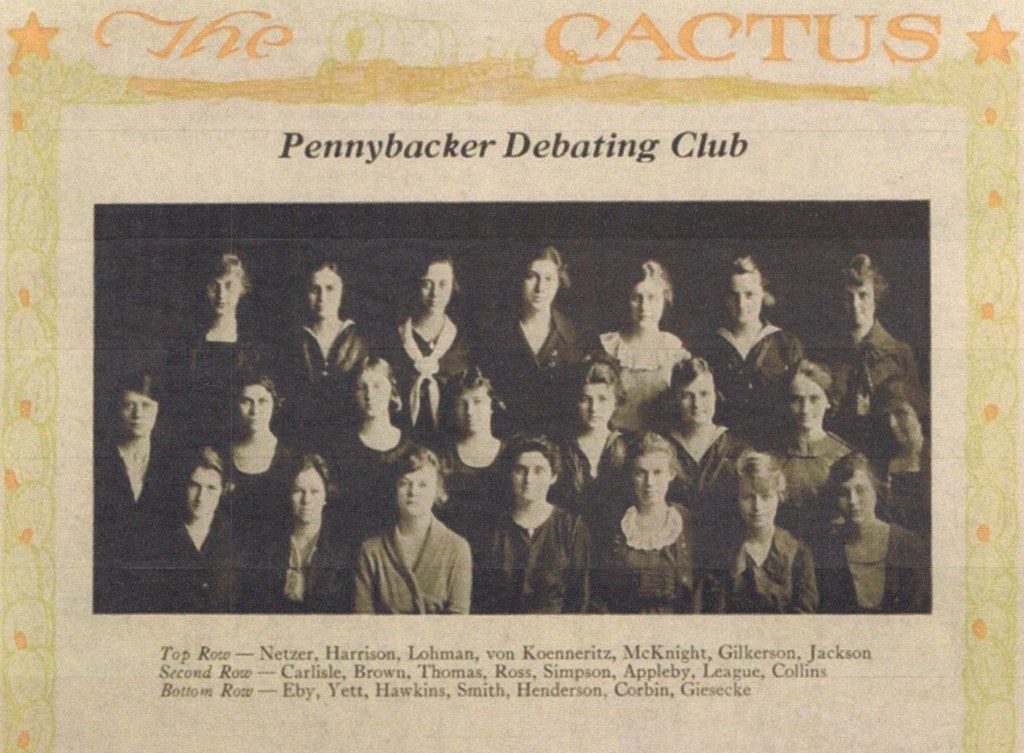
As her list above shows, Elsie first attended a junior college after graduating from high school and then enrolled at the University of Texas in the fall of 1918. She may have lived off campus initially since she is listed in an Austin American Statemen article dated November 17, 1919, as among girls initiated into the women’s dorm. On December 21, 1919 the same newspaper tells us Elsie is the reporter for the newly formed New Mexico Club at the University of Texas. In the 1920 University of Texas yearbook, The Cactus, Elsie is photographed in the Pennybacker Debating Club, and later, in December, the Austin newspaper states she was elected president of this club.
Elsie Brown second from left in the second row, from The University of Texas 1920 yearbook The Cactus.
In March 1921, Elsie participated in the finals for the “Boone prize,” an extempore speaking competition held at the University of Texas Law Building. The competition awarded a $50 cash prize to the top boy and girl speakers. Elsie was one of six girls and six boys who gave speeches on the general subject of the Kansas Court of Industrial Relations. She received an honorable mention, coming in second place to another girl.
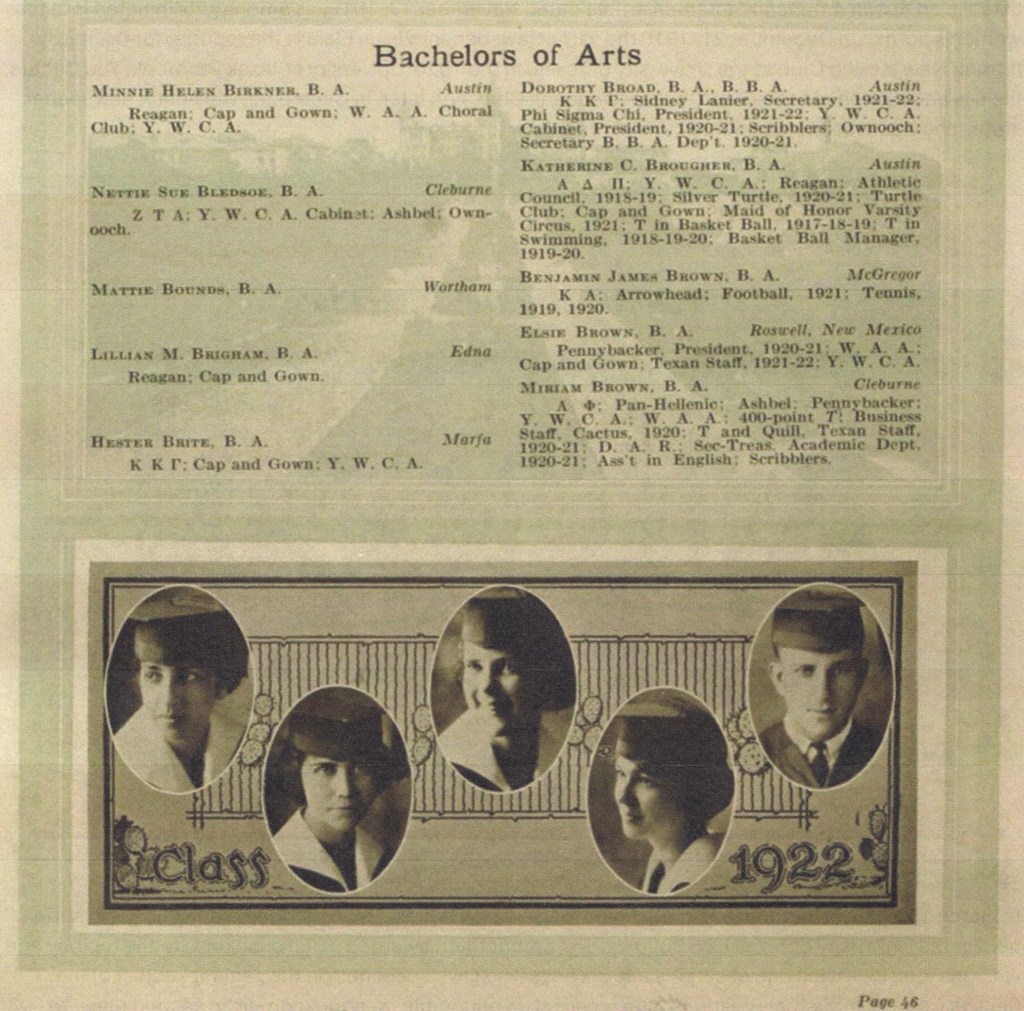
During her final year at the University of Texas, Elsie was a reporter for the school newspaper, the Daily Texan, and contributed articles to the Austin American Statesman, some of which were published on May 16, 1922. She was also appointed as the chairman of the Woman’s Athletic Association, which aimed to launch a monthly publication titled “The Sports Girl” to showcase the achievements of the Varsity female athletes. Elsie held the position of editor-in-chief for this publication. In addition to her journalistic pursuits, Elsie was actively involved on campus and graduated with a Bachelor of Arts degree, majoring in English with a minor in French.
According to census and voter registration records, at the same time Elsie was living in Los Angeles, her uncle Overton Brown and cousin Joe F. McElhannon were also living in Los Angeles. Over, as he was more commonly known, was working as an accountant for a public accounting firm, and Joe, (the son of Mary Acie (Brown) and Robert Lee McElhannon) was an investigator for a commercial insurance company, as detailed in the 1940 Census. Over had been in the service during World War I, stationed in France from June 1918 through July 1919. Over had sent Elsie a Christmas card from France, which was found in her personal papers, along with a November 11, 1918 Stars and Stripes Newspaper published by the Army in France. Elsie must have cherished these items to have kept them, considering that her diplomas were not found with her papers. It must have been comforting to family members back in Texas and New Mexico that these three relations were together in the same town way out in California.
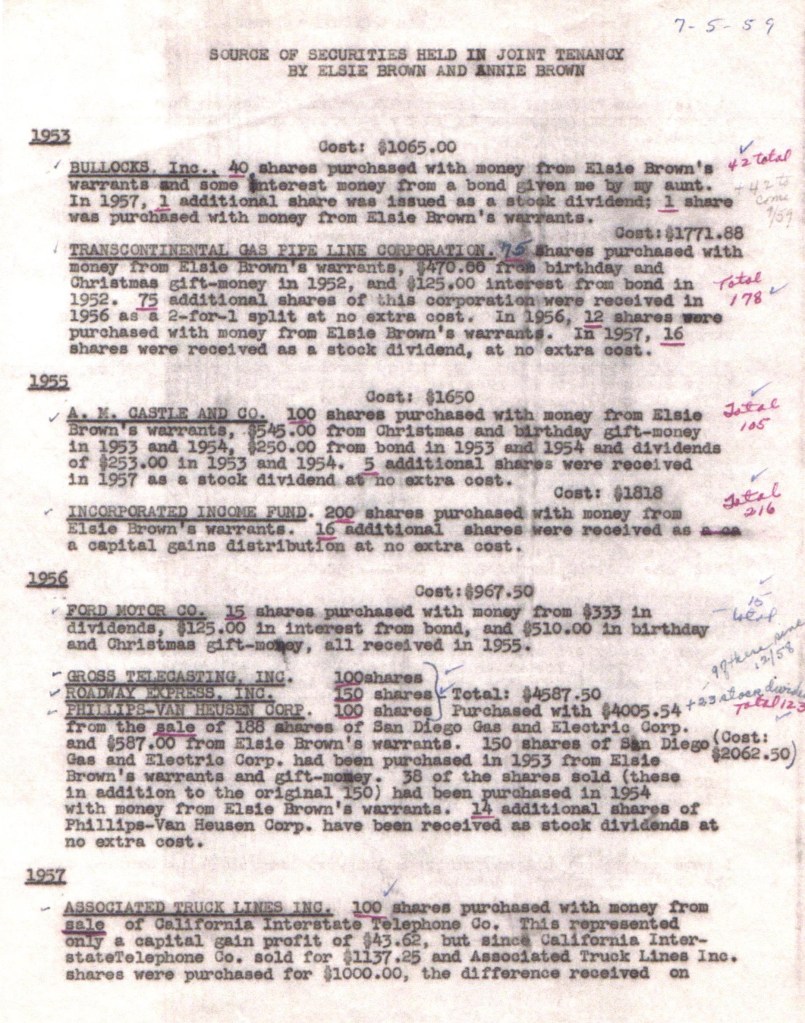
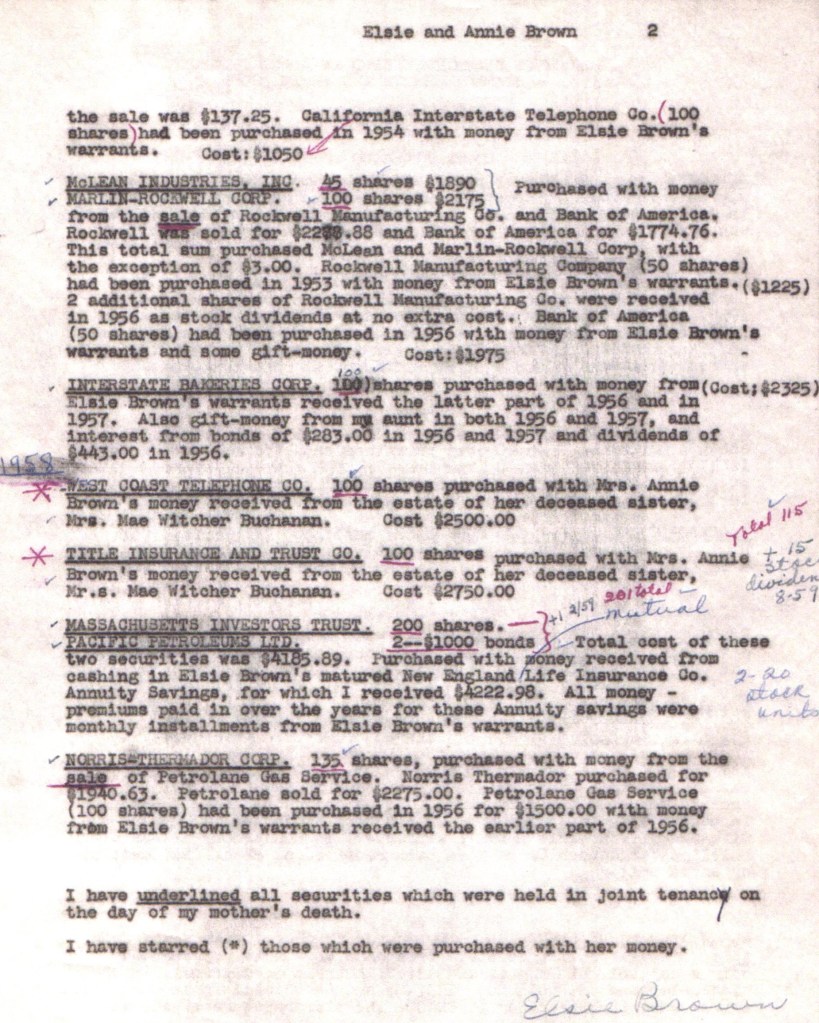
After Elsie’s father, Cephas, passed away on May 2, 1939, her mother continued to live alone in Roswell for about ten years before Elsie brought Annie to live with her in Los Angeles. This information is based on Annie Brown’s obituary, which stated that she died in Los Angeles, “where she had lived since 1948.” However, Annie’s death certificate indicated that she had lived in Los Angeles County for eighteen years and was residing at 4023 Garden Avenue. Perhaps this was when Annie began extended visits with her daughter in Los Angeles after Cephas died. The death certificate also stated that Annie died of cancer at Westmoreland Sanitarium. After laying her mother to rest in 1958, Elsie spent the next nine months settling her mother’s estate, which mainly involved separating their personal investments. These papers show Elsie had an impressive portfolio, which she had to document during this ordeal.
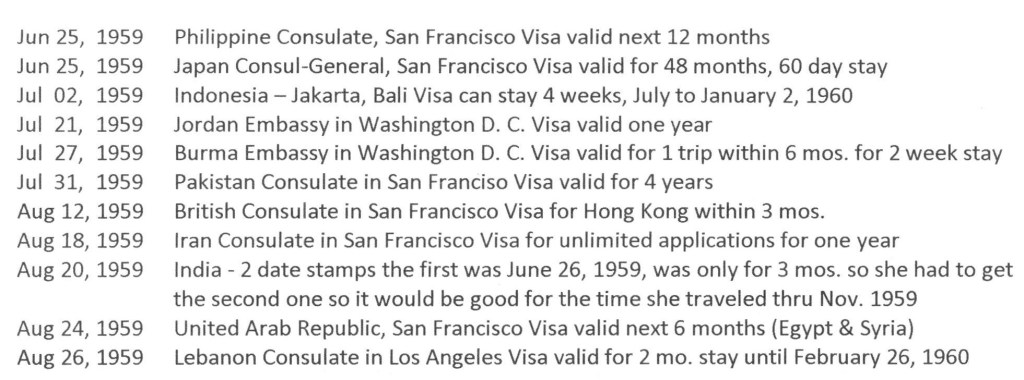
Through the spring and summer of 1959, Elsie was still working at Virgil Middle School. Now that her mother was gone, Elsie decided to take some time for herself and asked and received a sabbatical leave from her librarian position to take an extensive trip to explore Asia. On May 29, 1959, Elsie acquired a passport and, toward the end of June, began collecting visas for her trip.
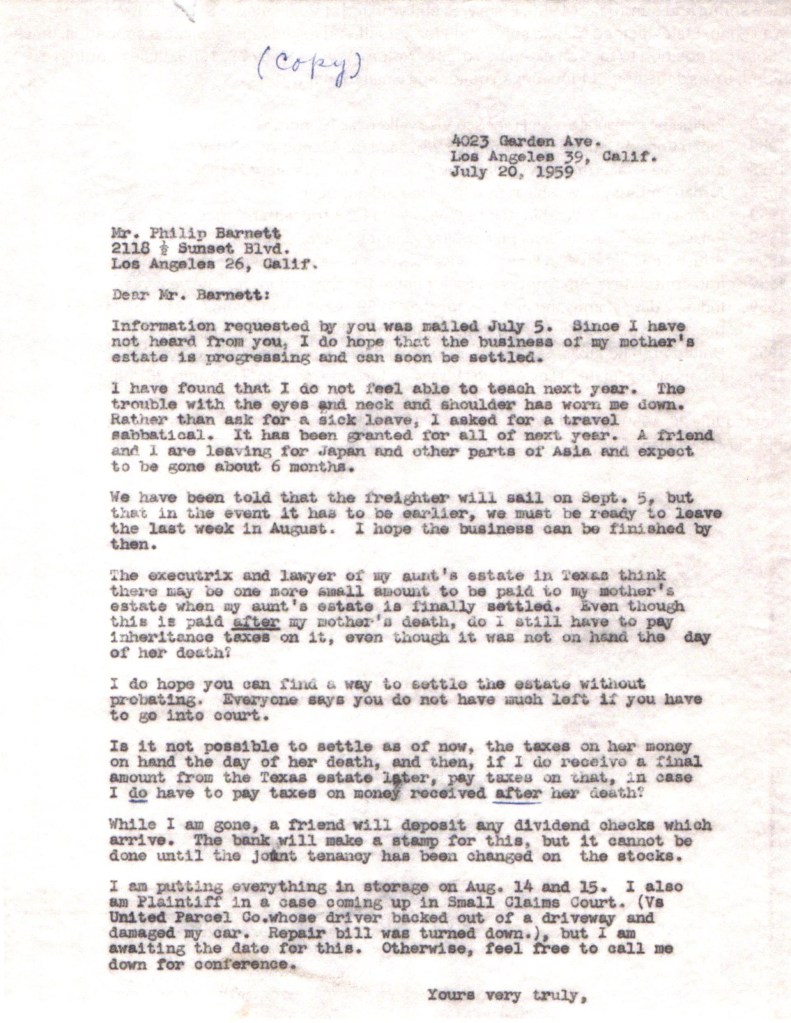
In a letter dated July 20, 1959, to the lawyer, Mr. Philip Barnett, who was handling Annie’s estate, Elsie reveals much about her travel plans.
On September 3, 1959, Elsie wrote a check for $537.09 to Allan Cranston, the Controller for the State of California, to settle the state inheritance taxes due on Annie Brown’s estate. It must have been a relief for Elsie to have this task taken care of before embarking on her travels. Her first stop was Japan. The entry and exit date stamps found in her passport detail the countries she visited.
Regrettably, Elsie fell ill during her trip, which resulted in cutting her travel plans short. There is speculation about whether the issues she mentioned in a letter to her lawyer regarding her eyes and a painful neck and shoulder were symptoms of this illness. Nevertheless, after returning home found the illness was medically untreatable, and she spent her last year getting her affairs in order and passed away on September 4, 1960. An obituary in The Los Angeles Times on Tuesday, September 6, 1960, stated, “She became ill last November while touring the world on sabbatical leave.” Her death certificate listed pneumonia as the cause of death with attributing factors of carcinoma of the lungs with generalized metastases. Similar to her mother, Elsie was brought back to Roswell and laid to rest near her parents in South Park Cemetery.
Elsie turned to her Aunt Clydine to take care of her last requests and settle her estate. Elsie had several local friends in Los Angeles that she called on to help her as well. In an old style “air mail” type envelope Elsie had left specific instructions for Clydine. The first page of its contents was dated December 7, 1959, less than a month after Elsie returned from her trip. It contained five handwritten pages of information Clydine would be needing such as the location of her will and her financial report, which was a duplicate of what she detailed six months earlier for her mother’s estate. Elsie also gave instructions on a few material items and money she wanted Clydine to distribute to her Los Angeles friends: Prunella and Frank Schubert, Elsie’s old roommate Mariet Lamb, Constance Sommer, Mary Inverson and to a neighbor who looked after the Roswell property, Jessie Russell .
The settlement of Elsie’s estate dragged on until May 1963. Saying goodbye to Elsie must have been very difficult for Clydine. They were less than two months apart in age, both graduated top of their high school classes and had very similar careers. Neither ever married. Clydine would continue life for another thirty years without Elsie to confide in.
A couple more posts on the Stickney/Brown family will soon follow.
Annie Oleana (Stickney), Elsie, and Cephas Hampton Brown ~1898.
The first information about Cephas and Annie’s whereabouts after marriage is in Sherwood, Texas, in 1904. Sherwood is about 30 miles southwest of San Angelo, Texas. This information is from a San Angelo Press newspaper dated August 4, 1904, which simply stated “Cephas Brown of Sherwood was in San Angelo Tuesday.” Cephas’ brother Creek Brown had a barber shop in Sherwood during this same time and continued to live there after Cephas and Annie relocated to New Mexico. Annie Brown’s obituary clipping from an unknown newspaper begins “Mrs. Annie Brown, 84, who with her husband and their daughter Elsie, came in a covered wagon from Sherwood, Tex., to Roswell in 1905 . . .” The Roswell Daily Record, confirms this move in their October 5, 1905 issue under the heading of “The Deals in Realty” that “Sam Jones and wife to C. H. Brown for $1, lot 24, block 1, of Valley View addition to Roswell.” This would have been for their first home on South Lea Avenue, presently near Valley View Elementary School. The Tucumcari News reported on January 20, 1906 “Sephus [sic] Brown, a blacksmith, came in Wednesday from Dawson, and is going out to the Bell Ranch to take charge of their shop.”
The local newspaper, Roswell Daily Record, gives insight into other family members living in and visiting Roswell during these early years. Annie’s sister, Mae Stickney, was attending Woolverton Practical Business College in the fall of 1906, and it was reported in the newspaper she had won a limited scholarship. The following year, the newspaper reported on her movements back and forth between Roswell and Kenna. Kenna is about sixty miles northeast of Roswell and, at the time, was the largest cattle shipping point in New Mexico. At Woolverton, Mae learned stenography and was working as such in Kenna for the U.S. land office. Mae was also teaching at Woolverton in September 1907 when she moved away apparently accepting a new position in Midland, Texas. The newspaper also tells us Annie and Mae’s brother, Alvin, had been living in Roswell since early 1906: “Alvin Stickney left last night for his home in Robert Lee, Texas having been making his home here for the past eighteen months.” Annie’s mother, Elvira, and two daughters, possibly Jessie and Clydine, the only unmarried children who would have been living with her in Robert Lee, visited during the summer of 1908.
The Roswell Daily Record, June 16, 1908 issue.
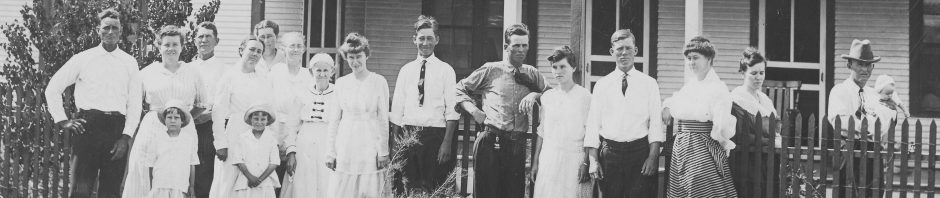
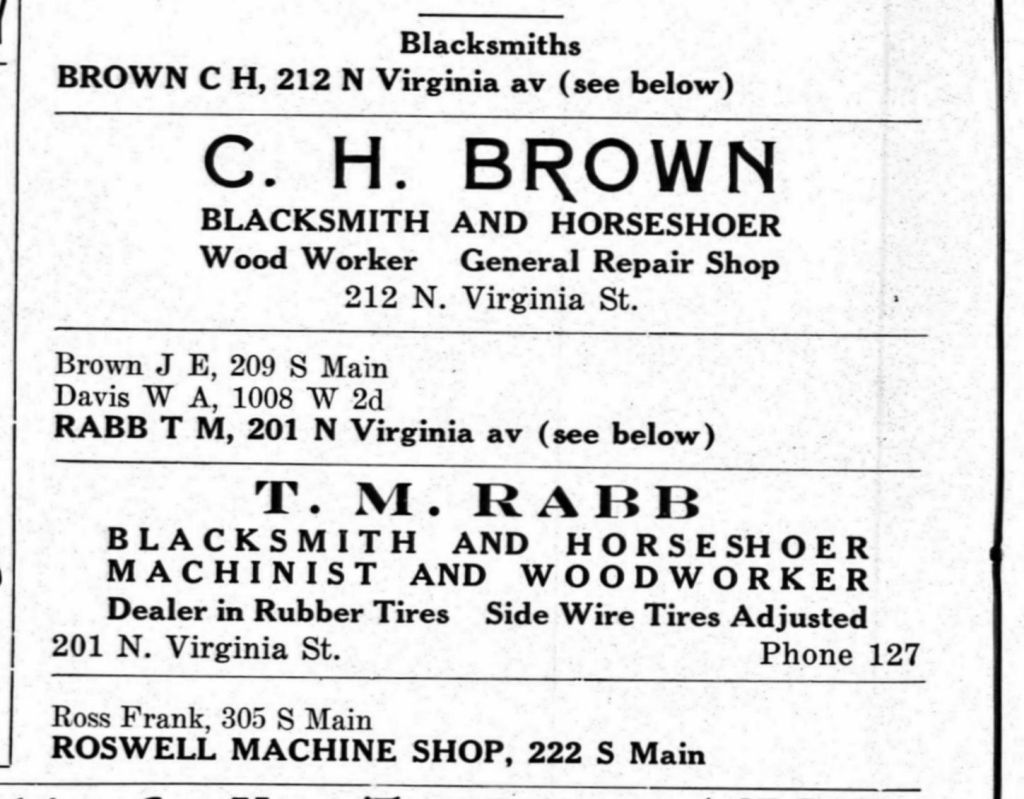
The 1910 census confirms Elsie was the only child born to Cephas and Annie during their thus far twelve-year marriage, with Cephas earning his livelihood as a blacksmith. Roswell City Directories reviewed on Ancestry reveals a consistent record of Cephas and his family from 1912 through 1935. Initially, they resided at 1001 S. Lea Avenue until at least 1916, when a relocation to 109 S. Pennsylvania Avenue positioned them closer to the town’s center and Cephas’s blacksmith shop at 212 N. Virginia Avenue. This move may have stemmed from Annie bringing her mother, Elvira, to live with them, a decision possibly made around the summer of 1915, coinciding with a family gathering celebrated in the header photograph on this website. This gathering likely honored Elvira’s youngest daughter, Clydine, as she graduated at the top of her high school class. Living with the Browns in Roswell, Elvira would also witness her granddaughter, Elsie, achieve the same academic heights of graduating first of her class from Roswell High School the following year. Sadly, Elvira’s presence with the family was short-lived, as she passed away on April 12, 1917, and was buried at South Park Cemetery in Roswell.
The following Roswell city directory listings show how Cephas’ blacksmith business progressed through the years. Cephas often worked with a partner as shown below.
This ad shows Cephas was working with E. Luther Brown and though both are named Brown, do not believe them to be related. The next edition of the directory did not show them still in business together and subsequent listings showed E. Luther Brown working at the post office. The 1913 directory listing below shows Cephas working alone.
Worley’s Directory of Roswell, New Mexico 1913
In 1918 a new publisher listed trades together on the same page to reveal Cephas’ competition.
Once again Cephas is working with a partner in 1920 and added woodworking to their skills.
Hudspeth Directory Company’s Roswell City Directory 1920
Cephas Brown’s Blacksmithing Shop in Roswell, New Mexico
In subsequent city directories after 1920, Cephas’ larger ads do not appear, but he is still listed as a blacksmith in the personal sections in the directories of 1922 and 1924. According to his obituary written many years later, his blacksmithing career ended in 1928 when he became “crippled”, evidently suffering an accident that caused paralysis. The 1930 US Census shows Cephas and Annie living in Deming, New Mexico, renting a home at 315 S. Iron Street. The Roswell city directory of 1930 shows a Sigurd Hansen living at 109 S. Pennsylvania Avenue, evidently renting their home while they are in Deming. This move may have been the result of Cephas’ medical issues. A news item from the Deming Headlight of July 25, 1930, states “Miss Elsie Brown is here from Los Angeles to spend the summer with her parents, Mr. and Mrs. Cephas H. Brown.” Another article from the same newspaper, dated July 7, 1933, states “Miss Elsie Brown of Los Angeles was the guest of Mr. and Mrs. Harry Latham Monday. She was enroute to Roswell.” Showing Cephas and Annie are once again living at 109 S. Pennsylvania Avenue in Roswell. Deming is located in southeast New Mexico and if Elsie were driving from her home in Los Angeles to Roswell, Deming would have been a convenient stop.
Cephas and Annie appear to be living in retirement for the rest of the 1930s; the only mention of their whereabouts is from items in Texas newspapers about family gatherings. In early September 1935, the Lubbock Morning Avalanche reported on a large family reunion hosted by Cephas’ brother and wife, Mr. & Mrs. Creek Brown in their new home in Lubbock. Creek, who worked as a barber in Sherwood, was now in law enforcement. Cephas, Annie and Elsie were in attendance along with Annie’s sisters Mae Witcher, Clydine, Emma Smelser, Hesta and her husband Harry Hall. Then again they gathered at Daniel and Mae (Stickney) Buchanan’s home in Colorado City for Easter in April 1938. This was probably the last time the eight siblings and their spouses were all gathered in one place.
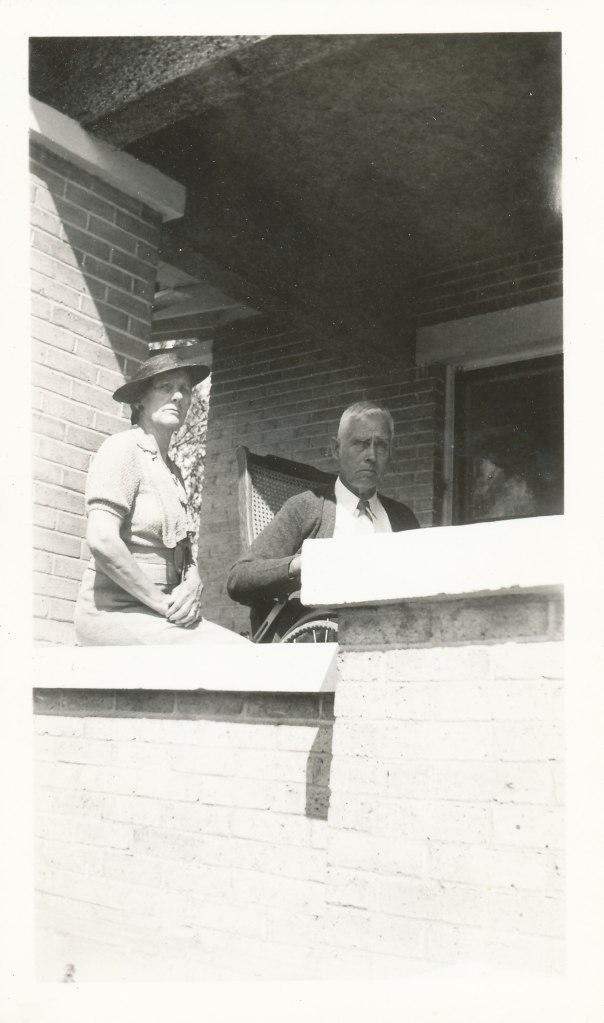
Cephas and Annie in Colorado City, TX 1938
Cephas and Annie Brown had watched the seemingly independent single product of their union graduate high school and college and return home as a teacher, probably hoping Elsie would remain near them in Roswell, but that was not to be. They raised her to aspire to new heights and off she went with her teaching credentials to the west coast. While back in Roswell Cephas struggled with his health, Elsie returned during the summer months and often traveled with her parents to family gatherings in Texas. Cephas Hampton Brown died on May 2, 1939, and was buried at South Park Cemetery in Roswell. Not long after and just before the United States entered World War II, Annie traveled to her brother’s home in Midland, Texas in August 1941 and was joined by sisters Mae, Hesta, and Clydine from various places in Texas. Alvin and his wife, Bessie, and their three sons Frank, Billy and Francis, hosted the group at a cookout at Cloverdale Park as related in an August 4, 1941, Midland Reporter-Telegram article. Annie also attended Lula Belle and Joe Sauls’ fiftieth wedding anniversary at their home northwest of Hamlin, Texas on August 30, 1942. According to her obituary, Annie continued to live alone in their home in Roswell until 1948 when she moved to Los Angeles to live with Elsie. The 1950 US Census shows Annie and Elsie living in an apartment at 3384 Ben Lomond in Los Angeles. Annie Oleana (Stickney) Brown died on December 12, 1958, and was buried at South Park Cemetery in Roswell next to Cephas and her mother Elvira.
Annie O. (Stickney) Brown and daughter Elsie Brown 1955
Annie Olena Stickney was the second of James Franklin and Elvira T. (Perry) Stickney’s ten children of which only eight survived to adulthood. Annie was the eldest of the eight surviving children, thus making her the big sister. Though the eldest she was not the first to marry and leave the family. Her next younger sibling, Lula Belle, had that distinction, marrying Joe H. Sauls in 1892. According to Coryell County marriage records, Annie and Cephas Hampton Brown were married by Elisha Terry on October 21, 1896, about a year before her family moved out of this county to Robert Lee, Coke County, Texas. A delayed Hamilton County, Texas birth certificate indicates their only child Elsie Brown was also born before they left the Coryell and Hamilton County areas on September 22, 1897. So who were these Browns that Annie married into?
Cephus Hampton and Annie (Stickney) Brown marriage record.
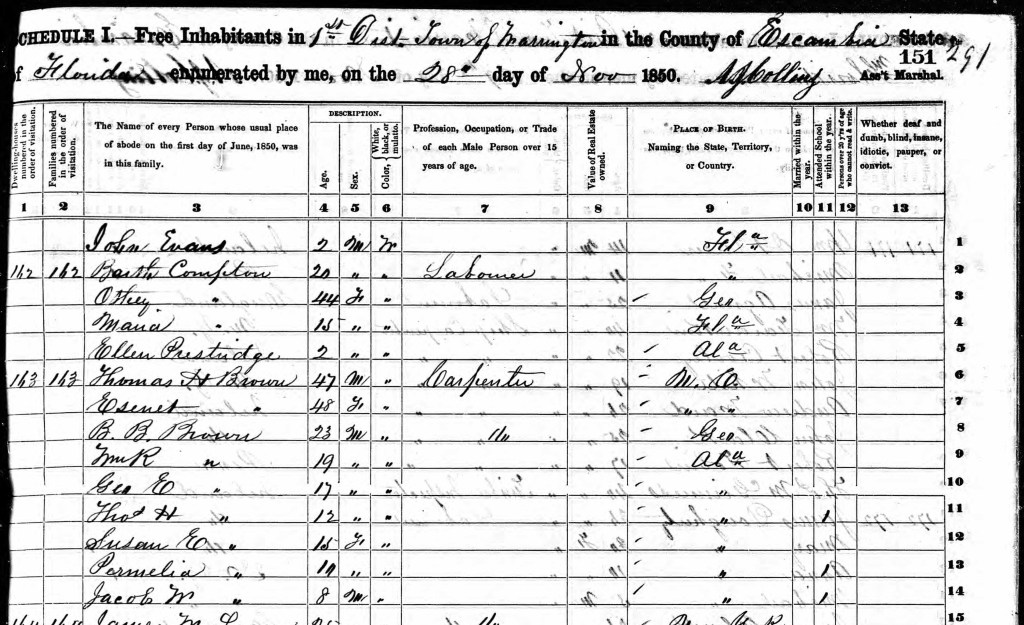
Cephus H. Brown was the son of Thomas Hyman and Martha Josephine (Elkins) Brown. Though both Thomas and Martha were born in Alabama according to census records, they had each come to Texas with their parents before the Civil War. A Texas Civil War pension application Martha submitted after Thomas died indicates she was born in Marengo County, Alabama, and had lived in Texas 73 of her 74 years, her age when she initiated this application, indicating her family came to Texas about 1852. It seems Thomas’ family took an indirect route to Texas through Florida where they are found in Warrington, Escambia County, Florida in 1850.
1850 US Census for Warrington, Escambia Co., Florida
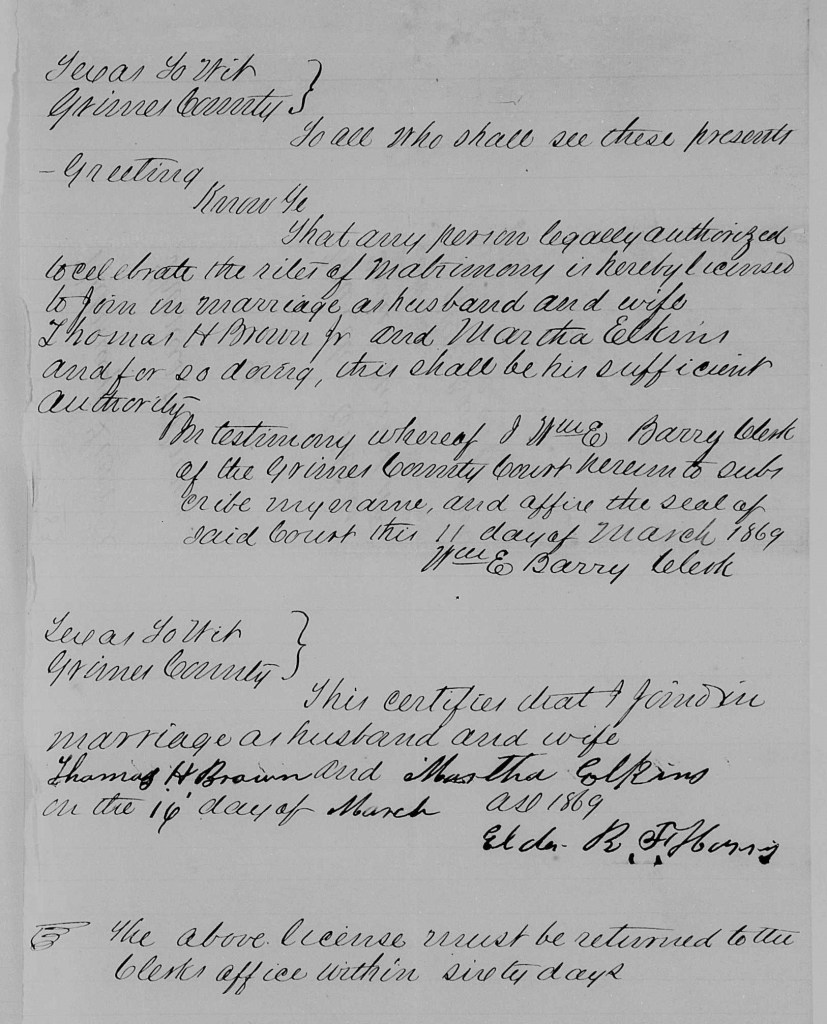
By 1860 the US Census shows this Brown family enumerated in Plantersville, Grimes County, Texas though only the younger children are present with the parents. After the Civil War, Thomas and Martha are united in Grimes County where they were married on March 16, 1869.
Thomas H. and Martha (Elkins) Brown marriage record.
Their first child Creek Brown was born in 1870 in Calvert, Texas, and their next son Cephas Hampton Brown was born in Bastrop County, Texas before the family settled down in southern Hamilton County, Texas where the rest of their twelve children were born. The 1880 US Agricultural Census for Thomas Brown in Hamilton County tells us he was principally raising sheep, having a flock of 830 sheep as of June 1, 1880. Thomas would live the remainder of his life here watching his children grow, marry, and most of them leave this area to live and raise families elsewhere.
Thomas Hyman and Martha Josephine (Elkins) Brown Family
THOMAS HYMAN BROWN was born on 17 Apr 1838 in Alabama son of Thomas Hyman Brown and Acenath Mayo. He died on 04 Mar 1916 in Hamilton, Texas (buried Jonesboro Cemetery, Jonesboro, Coryell). He married MARTHA JOSEPHINE ELKINS, daughter of Wade Elkins and Mary Jane Hawkins, on 16 Mar 1869 in Grimes, Texas. Martha or “Mattie” was born in Dec 1850 in Marengo, Alabama. She died on 03 Jul 1934 in Waco, McLennan, Texas (buried Jonesboro Cemetery, Jonesboro, Coryell).
Thomas Hyman Brown and Martha Josephine Elkins had the following children:
CREEK BROWN was born on 18 Jan 1870 in Calvert, Robertson, Texas. He died on 25 Mar 1954 in Wink, Winkler, Texas (buried Kermit Cemetery Kermit, Winkler, TX). He married JULINA KATHERINE HARKINS on 25 Sep 1892. She was born on 05 Feb 1871 in Texas. She died on 06 Jul 1966 in Winkler, Texas (buried Kermit Cemetery Kermit, Winkler, TX).
CEPHAS HAMPTON BROWN was born on 25 Oct 1872 in Bastrop County, Texas. He died on 02 May 1937 in Roswell, Chaves, New Mexico (buried South Park Cemetery, Roswell, New Mexico). He married ANNIE OLENA STICKNEY, daughter of James Franklin Stickney and Elvira Tennessee Perry, on 21 Oct 1896 in Jonesboro, Coryell, Texas. She was born on 27 Aug 1874 in Jonesboro, Coryell, Texas. She died on 12 Dec 1958 in Los Angeles, Los Angeles, California. (buried South Park Cemetery, Roswell, New Mexico).
MARY ACIE BROWN was born on 26 Feb 1875 in Hamilton County, Texas. She died on 14 Sep 1966 in Houston, Harris, Texas (buried Valley Mills Cemetery, Valley Mills, Texas). She married ROBERT LEE MCELHANNON about 1906. He was born on 22 Sep 1876 in Texas. He died on 04 Oct 1938 in Waco, McLennan, Texas (buried Valley Mills Cemetery, Valley Mills, Texas).
HUGH BROWN was born on 31 Jul 1876 in Hamilton County, Texas. He died on 18 Aug 1940 in Lampasas, Lampasas, Texas (buried in Ross Cemetery, Baird, Texas). He married 1st OLLIE BRUCE on 1 Nov 1900 in Hamilton, Texas. Ollie was born Mar 1881 and probably died between 1905 and 1909. Hugh married 2nd MAUDE J. ESTELL on 27 Oct 1909. Maude was born in 1891 and died in 1939 (buried in Ross Cemetery, Baird, Texas).
LOYGENE BROWN was born on 24 Jan 1878 in Hamilton County, Texas. He died 27 Dec 1939 in Meridian, Bosque, Texas (buried Jonesboro Cemetery, Coryell County, Texas). He married BESSIE FRANCES ELAM on 28 Jun 1914 in Hamilton, Texas. She was born on 29 Dec 1883 and died on 11 Nov 1979 (buried Live Oak Cemetery, Hamilton County, Texas).
OLLIE BRUCE BROWN was born on 04 Dec 1880 in Hamilton County, Texas (twin to Osie). He died on 02 Jul 1906 in Hamilton, Hamilton, Texas (buried Jonesboro Cemetery, Coryell County, Texas).
SETH BROWN was born on 17 Oct 1883 in Hamilton County, Texas. He died young on 16 Apr 1886 (buried Jonesboro Cemetery, Coryell County, Texas).
THOMAS OVERTON BROWN was born on 07 Sep 1887 in Hamilton County, Texas. He died on 18 Dec 1956 in Ft. Worth, Tarrant, TX (buried Greenwood Memorial Park, Ft. Worth, TX). He married IDA CHATHERINE WALKER on 13 Dec 1942 in Bellevue, Clay County, Texas. She was born about 1891. She died before 29 Sep 1984 (buried date, Greenwood Memorial Park, Ft. Worth, TX).
VIRTA BROWN was born on 31 Jul 1889 in Hamilton County, Texas. She died on 26 Nov 1979 in Houston, Harris, Texas (buried Meridian Cemetery, Meridian, Bosque, Texas). She married CHARLES WRIGHT FUQUA on 14 Jul 1912 in Hamilton, Hamilton, Texas. He was born on 16 Nov 1887 in Hamilton, Hamilton, Texas. He died on 23 Jul 1951 (buried Meridian Cemetery, Meridian, Bosque, Texas).
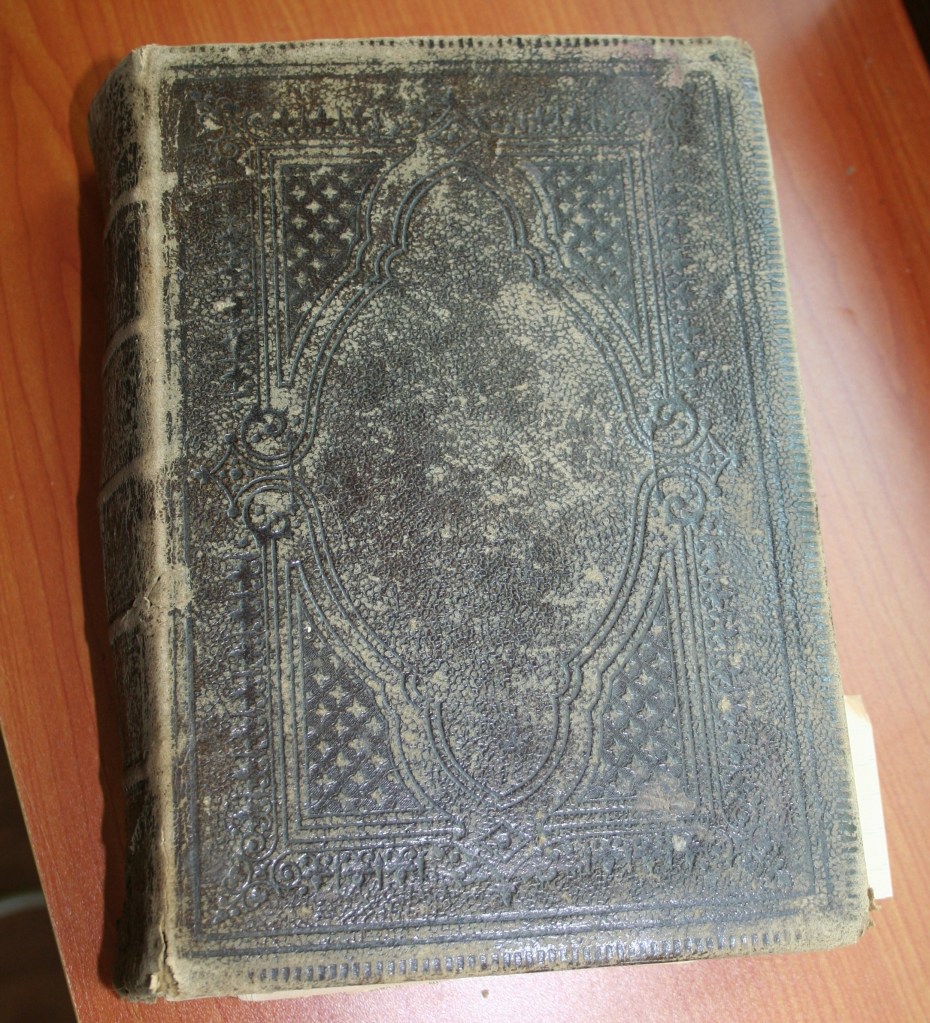
In 2019, I acquired the James Franklin and Elvira T. (Perry) family bible, a family heirloom that had been stored in an attic for several years, protected from dampness by the dry West Texas climate. Despite this safeguard, the Bible bears the marks of time, with a worn cover and loose pages, particularly the family record section. Enclosed are photos of these pages, revealing invaluable information within.
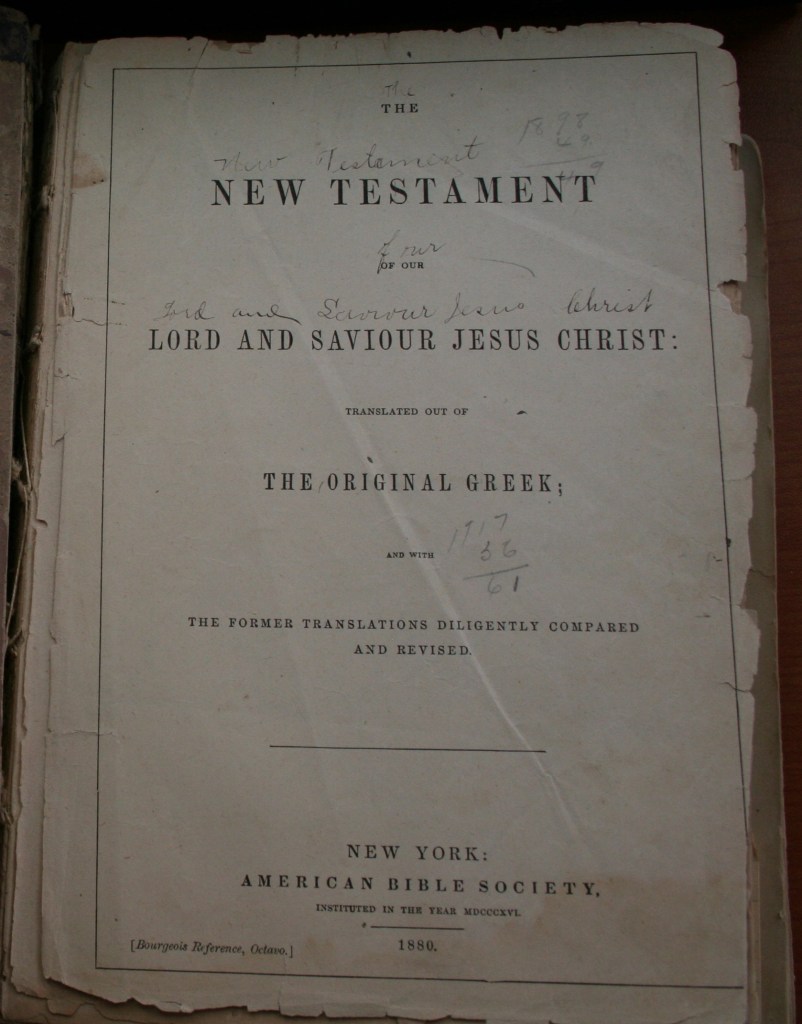
Title Page
The title page, though tattered shows signs of perhaps someone practicing their handwriting, as well as calculating the age of Elvira, the mother, at the time of her death.
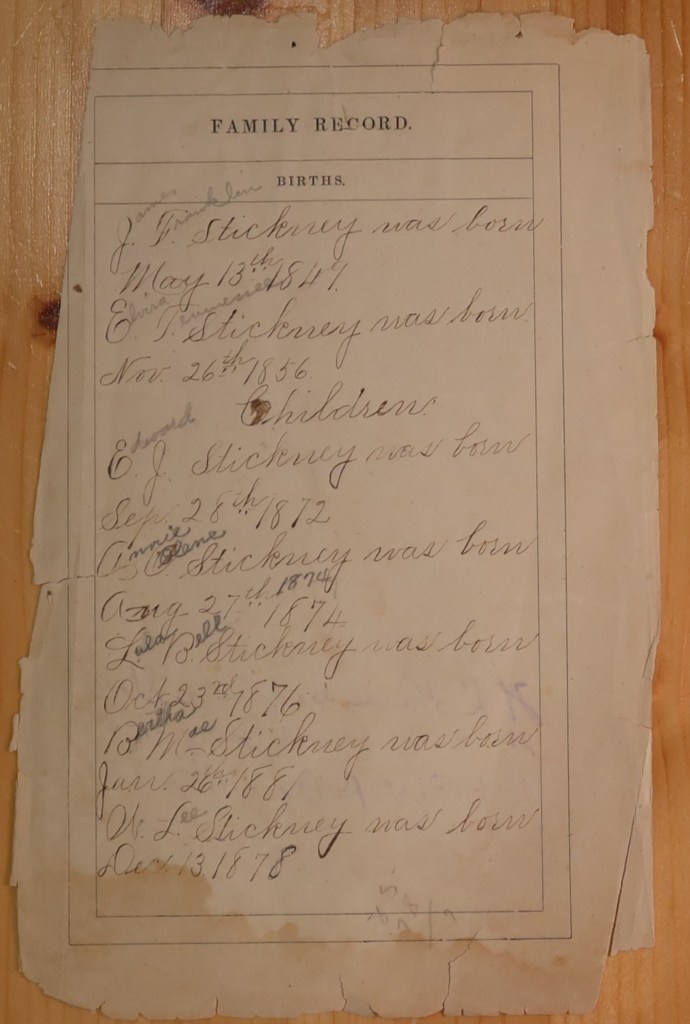
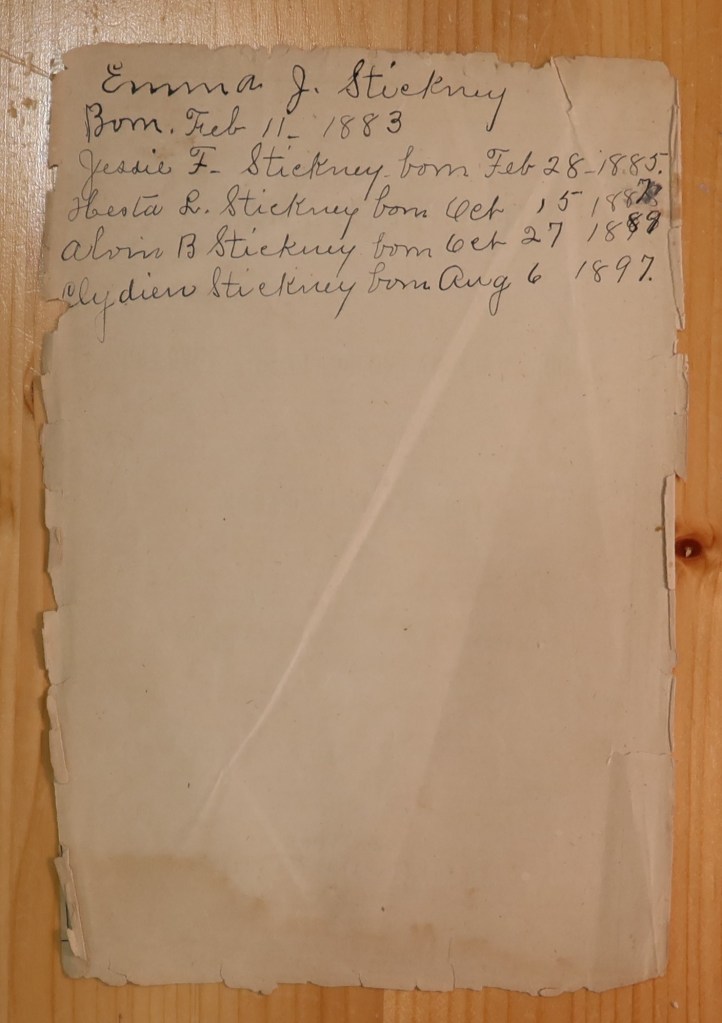
Births
Births page 1 – Initials were initially recorded for given names, later supplemented with full names.
Births page 2 – Unfortunately, this page is not intact, which likely prompted someone to reenter the births on the back of the title page, as shown below.
Births page 3 – A couple of the birth years were mistakenly recorded and corrected, evident that these were entered at a later date and not soon after the births occurred.
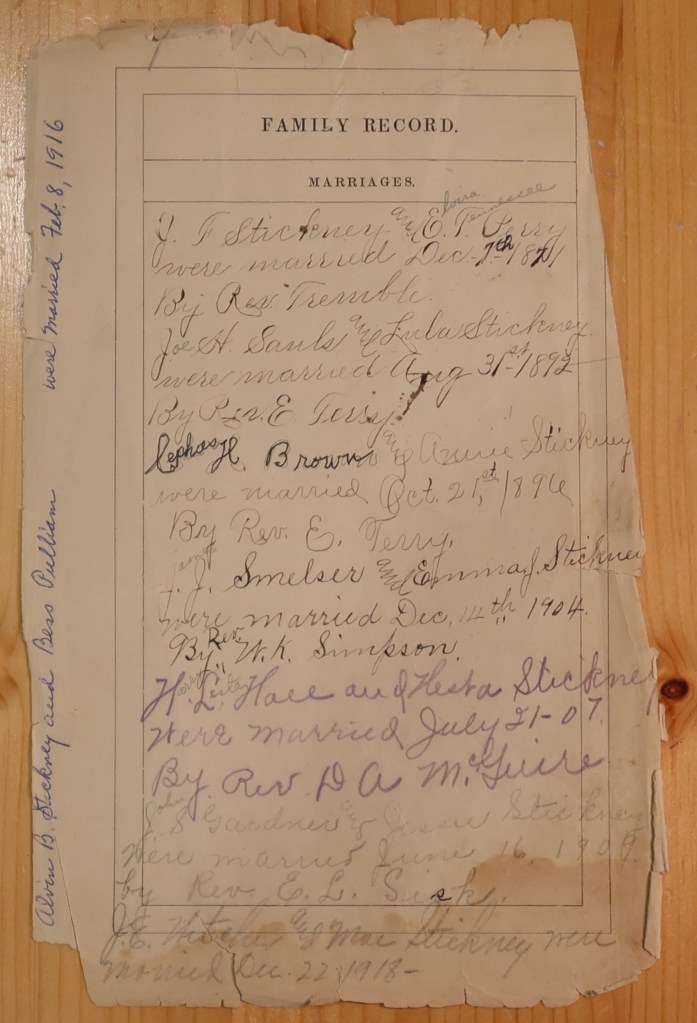
Marriages
Interestingly these marriage records include the officiant who united the couples and were recorded in the order they occurred, except for the only surviving son, Alvin, whose marriage is written in the margin at a later date and appears to be Clydine’s handwriting.
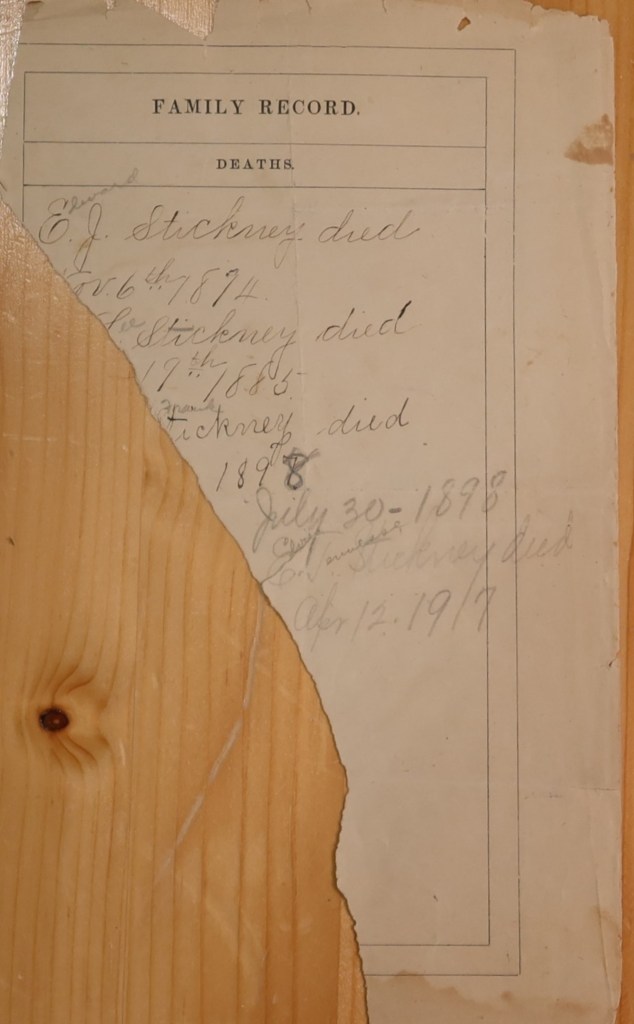
Deaths
The deaths shown here on back of the torn birth page, though consists of only four deaths, speak volumes. Showing us the young sons that died early, children that are often missed in a family group.
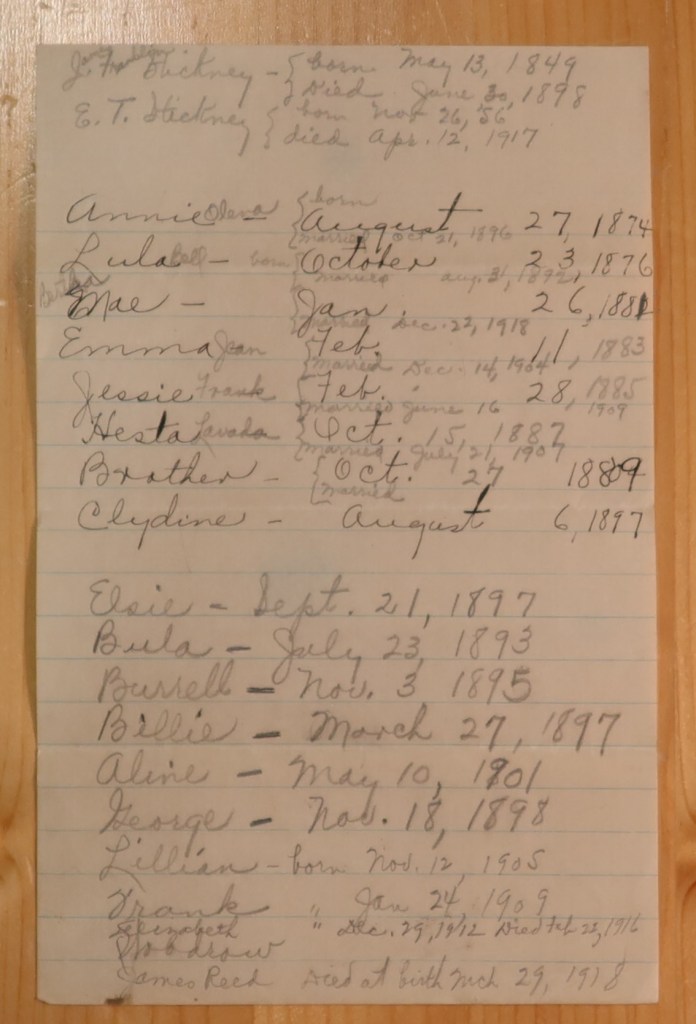
The next two pages were folded and inserted between the pages of the Bible and re-record the birth and death dates of the parents, Elvira and Frank, and list their surviving children giving their birth and marriage dates only. Then the grandchildren’s given names are listed, grouped somewhat chronologically. Lastly, two great-grandchildren are listed with their birthdates.
The following record that was not found in the family Bible, but was written by Clydine, includes more death dates for her siblings.
Within the pages of the Bible were evidence of two flowers that were pressed between the pages and a few other items that I thought were interesting to photograph and include.
India Linon was French linen, a fine, light weight fabric often used for kerchiefs. Fabric, Elvira may have used as a seamstress. Cures kept handy in case needed. Wondered if the the red McLaughlin clipping was merely a bookmark.
I presume this well used family Bible remained with my great-grandmother, Elvira, until her passing in 1917, while she resided with her eldest daughter, Annie, in Roswell, New Mexico. Annie likely kept it until her own death in 1958, while living with her daughter, Elsie, in Los Angeles, California. Elsie’s aunt, Clydine, cared for her a few months until she passed away from cancer in 1960. Clydine was the youngest and last of her immediate family to possess the family Bible. My father, Francis Stickney, assisted in settling Clydine’s estate after she passed in late 1989 and became the next custodian of the Bible. Now in my possession, I share its contents hoping to keep the memory of this family alive.
I was initially surprised to learn of Clydine’s top of her class accomplishment and had never heard about it from my father or anyone else in the family. All I knew growing up was that she was a school librarian, but it turns out she was much more. As valedictorian Clydine earned scholarships from every major college in Texas. Among her papers were certificates or letters from University of Texas, Texas Women’s, SMU, College of Industrial Arts, Southwestern and Midland College. I didn’t find one for North Texas Normal College and Teacher Training Institute located in Denton, Texas where she enrolled after high school. From her copy of the 1916 yearbook, The Yucca, she is listed as a Junior in the Primary Arts department and states she is from Woodland, Tx which I believe to be an error. I found another listing for Clydine in a Denton newspaper article titled “Over 900 Students in North Texas State Normal College”, that I believe to be more accurate than the yearbook which simply listed “Stickney, Clydine, Midland; J. J. Smelser, 126 Maple”. J. J. Smelser is her brother-in-law, married to her sister Emma, this might be why she studied at North Texas, where she could live with her relatives.
In her one year at North Texas, Clydine receive a first-grade certificate and a recommendation letter that helped land her first teaching job in Afton, a town in Dickens County in the panhandle west of Lubbock. The record she created for the Teacher Retirement System of Texas shows she only taught eight of the nine months of the school year in Afton. It could be that she started the school year late, but possibly she didn’t finish out the year due to her mother’s death on April 12, 1917.
Her mother, Elvira had been living in Rowell, New Mexico with her eldest daughter, Annie Brown, when she died. Her funeral and burial were in Roswell and it is not known if Clydine attended, but we find her back in Robert Lee the following school year where she was teaching at Simpson School. This was a small one room type school near Robert Lee. Her class consisted of twenty students, ranging in age from six to twenty years in grades first to ninth and ran eight months from September 24, 1917 to May 13, 1918.
Clydine moved around a lot in her first ten years of teaching and continued her own education taking courses at local colleges and correspondence courses. To finish up her degree she took a year off from teaching to be a fulltime student at the University of Texas. Clydine graduated from UT June 7, 1926 with a Bachelor of Arts degree and is pictured in her cap and gown in the yearbook, “The Cactus” giving Lubbock, Texas as her home.
Clydine’s teaching records provide when and where she was teaching but they don’t always state what she was teaching. Her University of Texas hours accumulation shows her degree was heavy on English courses with a total of 24 hours, then 18 hours each in Latin and Government, 10 hours each of Education and Sciences, and 2 hours each for Math, Bible and Psychology.
Her strong background in English resulted in a job teaching high school English at Abilene ISD for the 1926 – 1927 school year. The following year she taught in San Angelo at Central High School and remains there for ten years. While there she wrote to J. Frank Dobie requesting help starting a folklore society at the high school. Dobie was an English professor at the University of Texas when Clydine was a fulltime student and known for his love and involvement with the Texas Folklore Society. If she received a reply from him it was not found among Clydine’s papers.
In her fourth year at San Angelo Central High School Clydine’s position changed from teacher to librarian and she began taking classes in library science at University of Illinois during the summer in 1929 and received her Bachelor of Science in Library of Science degree on August 15, 1936. After completing her Library of Science degree, Clydine taught one more year in San Angelo then moved to Commerce in East Texas and began an eleven-year stint at Texas State Teachers College as a librarian. The 1940 US Census tells us Clydine was renting a home for $25 a month at 1701 Monroe St. Commerce, Hunt County, Texas. She was 42 years old, single, Librarian at State Teacher College where she worked 52 weeks a year at a $1900 annual salary.
The chart below shows all the places Clydine educated others and herself.
School Year
School
Address
Position
1914-1915
Midland High School
Midland, TX
Student
1915-1916
North Texas State Teacher College
Denton, TX
Jr. Class Student
1916-1917
Dickens County
Afton, TX
Teacher
1917-1918
Coke County
Robert Lee, TX
“
1918-1919
Andrews County
Andrews, TX
“
1919-1920
Clarendon ISD
Clarendon, TX
“
1920-1921
Andrews County
Andrews, TX
“
Summer 1921
University of Texas
Austin
Student
1921-1922
Clarendon ISD
Clarendon, TX
Teacher
Summer 1922
University of Texas
Austin
Student
1922-1923
“
“
Teacher
Summer 1923
University of Texas
Austin
Student
1923-1924
“
“
Teacher
Summer 1924
University of Texas
Austin
Student
1924-1925
Lubbock ISD
Lubbock, TX
Teacher
“
Clarendon College
Clarendon, Texas
Student
1925-1926
University of Texas
Austin
Student
1926-1927
Abilene ISD
Abilene, TX
Teacher
1927-1928
San Angelo ISD
116 E. Harris Ave., San Angelo
Teacher
1928-1929
“
San Angelo
“
Summer 1929
University of Illinois
Urbana
Student
1929-1930
San Angelo ISD
San Angelo
Teacher
Summer 1930
University of Illinois
Urbana
Student
1930-1931
San Angelo ISD
203 W. Twohig, San Angelo, TX
Librarian
1931-1932
“
“
“
1932-1933
“
“
“
1933-1934
“
420 W. Beauregard Ave, San Angelo, TX
“
1934-1935
“
San Angelo
“
Summer 1935
University of Illinois
Urbana
Student
1935-1936
San Angelo ISD
San Angelo
Librarian
Summer 1936
University of Illinois
Urbana
Student
1936-1937
San Angelo ISD
San Angelo
Librarian
1937 – 1948
East Texas State Teachers College
Commerce, TX
Librarian
1948 – 1962
Colorado City High School
Colorado City, TX
Librarian
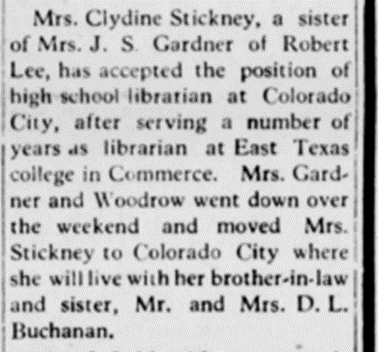
Clydine finished her career in Colorado City where she was head librarian at the high school. This, in a way, was her home coming and was noted in her hometown Robert Lee Observer newspaper, under “Folks You Know” section
By the fall of 1948 she was back in the west Texas area where she grew up and back near family. Her sister, Mae had been living in Colorado City since she married her second husband, Daniel L. Buchanan in 1935. The 1940 census shows that when they married, Mae moved into the home he had been living in at least since 1930. The 1930 census show Daniel Buchanan head of household at the same 344 Walnut address with wife Ida and a thirteen-year-old son. I speculate that when Clydine came to Colorado City, Mae decided to buy a new home where the three could all live together. When Mae died November 15, 1957, her obituary states she was living at 643 Cedar. Mae’s husband continued to live there with Clydine for about six months before ill health caused him to move in with his son, Grover Buchanan in Abilene. Daniel died March 14, 1959.
Sister Mae was well off financially due to her first husband’s land holdings in Ector County that produce oil and gas royalties. She generously gave to her siblings while alive and when she died, Clydine was made executrix of her estate and continued to provide financial support. Mae’s will dictated that her surviving siblings would continue to receive the royalties from her oil and gas properties, but after the last one died the income would go to The Methodist Home for Children, originally located in Fort Worth.
Clydine was close to her niece, Elsie Brown since they lead very similar lives. They were less than two months apart in age and neither ever married and both were teacher who later became librarians. During the summer of 1960, Clydine went to Los Angeles where Elsie live and helped take care of her. Elsie had cancer and died September 4, 1960. Clydine retired in 1962 at the age of 65, but by then all of her immediate family was gone except for her brother, Alvin and sister Hesta. She bought her brother, Alvin, a cabin on Colorado City Lake so they could spend more time together and have a place to gather with her many nieces and nephews. Alvin, my grandfather, often took us grandchildren to the lake in the summers of the later 1960s and it is this setting for the fond memories I have of Clydine. She very much looked like a librarian, always properly attired in a dress with nice shoes and a handbag and my sister remembers her having a nice car.
Clydine lived fifteen years longer than her brother, Alvin, who died in 1974. Sister, Hesta, died earlier in 1972. In my grandfather’s photo album, there are several pictures of Clydine and a young man, but for unknown reasons they never married. Since she was executrix of her older sister, Mae’s estate she employed a lawyer, Frank Ginzel, to handle the directives of Mae’s will. As Clydine aged, Frank and his secretary, Sue Compton, managed her finances and looked after her needs as well. Several of Clydine’s nephews looked in on her as much as they were able living some distance away. My father, Francis Stickney helped his cousin, Wilfred Gardner, along with her lawyer handle her estate after Clydine died December 30, 1989. Clydine Catherine Stickney was laid to rest in Robert Lee Cemetery, Robert Lee, Texas alongside her father, James Franklin Stickney, and sister Mae (Stickney) Witcher Buchanan.
Clydine Catherine Stickney was born August 6, 1897 in Jonesboro, Coryell County, Texas, the youngest child of James Franklin and Elvira Tennessee (Perry) Stickney. She was very much the baby of the family born nearly eight years after her next youngest sibling, the only surviving son, Alvin Burton. In fact, Clydine’s sister, Lula Belle had three children prior to her birth. Though Clydine was by no means an only child, her siblings were not playmates and the two oldest had begun building their own families before she was born. At the time of her birth her family was planning a move from Jonesboro to Robert Lee, Coke County, Texas. Family lore is the move was made to improve James’ health. Though there is no death certificate to confirm his cause of death, it is believed he had tuberculosis and they moved from a somewhat humid climate to a much drier west Texas. Unfortunately, he died before Clydine’s first birthday, so Clydine grew up not knowing her father.
After James Franklin Stickney’s death, Clydine’s mother, Elvira, was forced to support herself and what children were left at home. The 1900 U. S. Census gives us a picture of what the household looked like, telling us that Elvira was a laundress and thankfully their home was owned free and clear of a mortgage. Two older daughters, Bertha “Mae” age nineteen and Emma age seventeen, were still living at home to help with the laundry business as well as with caring for two-year-old Clydine. Three more children rounded out the household: Jessie age fifteen, Hesta age twelve and Alvin age ten. All three were attending school. Although the family was without a father and the two older daughters were married and out of the house, two-year-old Clydine was being raised in a full house, but in the next ten years this household would slowly dwindle.
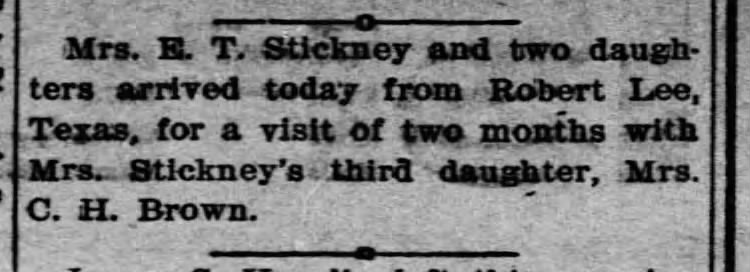
Between 1900 and 1910 Clydine saw her nucleus family change as her older siblings gradually drifted out of the home. Older sister Mae was living in Midland, Texas with a cousin, Sallie Perry and was working as a bookkeeper for Midland Metal Company. The 1910 US Census for Midland County, Texas where the information comes from shows that this Sallie Perry was working as a clerk at the post office and owned the home where they were living. Sister Emma married James J. Smelser in 1904 and had two daughters by 1910, and were living on Fleming Street in Sherwood, Irion County, Texas where James was a public-school teacher. Sister Jessie had just recently married John S. Gardner in 1909 and they were still living in Robert Lee with his parents where he was working as a district and county clerk and Jessie was a schoolteacher. Hesta too was married in 1907 to Harry L. Hall and they lived in Loraine, Texas where Harry was a barber in his own shop. It’s not known exactly where their brother Alvin was in 1910, but from a recording made in 1970 he states he left home at age 13 to work as a cow puncher on different ranches from Jones County Texas to Roswell, New Mexico. I did come across an item in the Roswell Daily Record newspaper published on Jun. 16, 1908 that stated “Mrs. E. T. Stickney and two daughters arrived today from Robert Lee, Texas, for a visit of two months with Mrs. Stickney’s third daughter, Mrs. C. H. Brown. I would guess the two daughters that came were Clydine and Jessie since they would have been the two still single and at home. By the end of the first decade of the twentieth century the family home in Robert Lee was much quieter with just Elvira and Clydine.
Clydine’s mother, Elvira’s occupation is shown to be upgraded in the 1910 US census from simple laundress to dressmaker, still working out of her home at age 52 and still classified a widow. The mistaken fact for Clydine states that she is five years old, but she would soon turn thirteen and below is a photo that appears to have been taken about this time.
When Clydine turned fourteen in August 2011 she moved to Midland, Texas possibly living with her older sister Mae. Clydine entered Midland High School as a freshman and certainly applied herself for in 1915 she graduated top of her class of fourteen students. Among Clydine’s papers and photos I inherited are a few things from her Midland High School days. First is a newspaper clipping, Juniors-Seniors in Annual Banquet. The newspaper is not named, nor article dated except “last Friday night” and also stated “The hosts greeted their guests at 9 o’clock in the parlors of the Llano . . .”. The article details the event being held in the dining room at the Llano Hotel, decorated in the senior class colors of yellow and white crepe paper. “. . . the tables were arranged in the shape of a cross. It was adorned throughout its length by vases of yellow or white roses.” The junior class sang a song they wrote mentioning “the personal peculiarities of the seniors such as their method of combing their hair, powdering their faces, getting their lessons, or attracting and holding their beaux.”
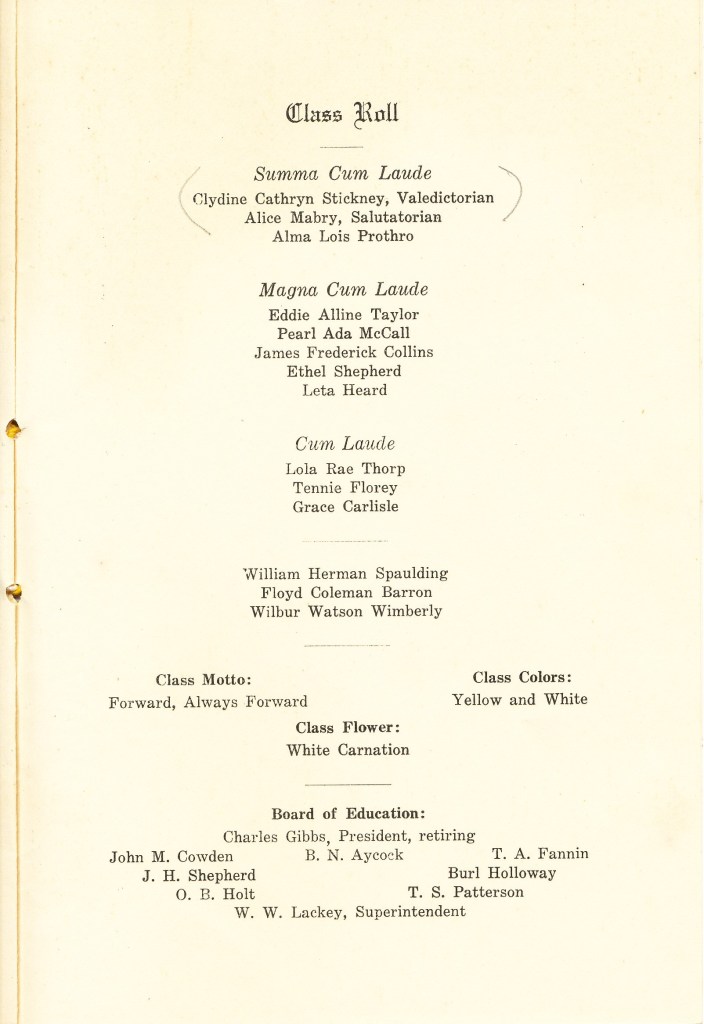
Her commencement program is tied with a yellow and white string and provides a schedule of her graduation week. The proceedings began with a church service at the First Christian Church on Sunday, May 23rd, 1915 at 11:00. Then “Class Day” was held on Tuesday, May 25th at the Opera House which included the orations of poems, essays and speeches, and performances of songs, and piano solos and duets. Again, at the Opera House the graduation exercises were held on Friday, May 28th, with many more choruses and orations. As valedictorian, Clydine presented an essay titled “Famous Friendships”, which sadly was not saved with these papers. Below is the last page of the program showing names of classmates and members of the Board of Education.
Clydine diploma is folded vertically and placed in a suede cloth folder with her name and class year printed in gold on the front, although her middle name Catherine, is spelled incorrectly as “Cathryn”.
One other thing Clydine received for her top honor was a spoon that has 1915 etched in the bowl and a female graduate figure as the handle.
Complications with Commonly Used Birth Information
Most family historians and descendants of the English immigrant William Stickney of Rowley, Massachusetts are not concerned with the facts of his origin in England and concentrate on the facts and path of descent from him to their own existence here in America. The particulars of his birth formally published in 1869, that he was baptized 6 Sep 1592, son of William & Margaret (Pierson) Stickney of Frampton, Lincolnshire, England, when examined do not measure up to the genealogical proof standard. Or one might question whether they are viewing the same records online that were used to determine this information published over one hundred and fifty years ago. Were there more detailed original parish records that are not available online today? A more recent study conducted in England in 1968 seem to indicate these are the same scantly detailed records. It is for that reason as well as overlooked burial records that seem to further discredit the validity of William’s commonly expressed origin, and why I find my research facing another brick wall as to when, where and to whom the immigrant William Stickney was born.
“WILLIAM STICKNEY, the first settler, was the ancestor of nearly all who have since borne the name in America. It is inferred from records procured in England for the author, by Horatio G. Somerby, Esq., that he was the William, who is mentioned as baptized in St. Mary’s Church, Frampton, Lincolnshire, England, September 6, 1592, and the son of WILLIAM STICKNEY of Frampton, who was baptized December 30, 1558, and married, June 16, 1585, Margaret Peirson, and the grandson of ROBERT STICKNEY of Frampton, who made his will October 3, and was buried October 18, 1582.”
Matthew A. Stickney uses the term “inferred” regarding these records, to perhaps note that he himself was not convinced that they were in fact the birth and parentage of the immigrant William Stickney. The source of this information, Horatio G. Somerby, was employed by several American family historian in the mid-eighteen hundreds to research their family origins in England that were later discredited. Not that he fabricated information but found records and produced a possible lineage. As noted in the preface to the book, Matthew A. Stickney mentions the town of Stickney in Lincolnshire where it is believed the surname originates so Lincolnshire would be a good place to look. The birth records commonly used as the birth date for the immigrant William Stickney are from St. Mary’s church in Frampton which is a short distance from the town of Stickney in Lincolnshire. But one cannot simply find a ”William Stickney” in records and conclude this is the immigrant William Stickney, it is necessary to find supporting details and/or additional records.
The parish baptism record used for the birth of the immigrant William Stickney can be found online at findmypast.com. This entry merely state a “ William Stickney” was baptized without giving any reference to a parent and appears to me to be September 16 not September 6, 1592. These records are extracts themselves and it is possible the original St. Mary’s church record provided more information about parents, but even if this birth record did show that this William Stickney’s parents were William Stickney (1558-1591) and Margaret (Pierson) Stickney (1562-1592/3), this still would not confirm this was the American immigrant William Stickney.
Below is my extract of the record found on findmypast.com, record set Lincolnshire Baptisms.
“1592 [noted on the previous page]
Septembr 16 wab{?] Thomas Sharpe ———— baptized
The same day wab[?] William Stickney ———- baptised”
The second more recent account of the immigrant William Stickney’s origin is by Emily Stickney Spencer published in 1970, English Ancestry of William Stickney of Rowley Massachusetts 1638. Emily travelled to England herself and using the findings of Somerby attempts to put together a detailed line of descent from a William Stickney (1465 – 1533) to the American immigrant William using many possible assumptions attained from court and parish records. The photocopy obtained of Spencer’s twenty-five-page publication is not well organized and has many typos. It consists of abstracts of Lincolnshire legal records involving suits, land transactions, and probates, along with parish baptism, marriage, and burial records. She presents transcribed wills of William Stickney (1558 – 1591), the supposed father of the immigrant, as well the will of Robert Stickney, the supposed grandfather, and the will of the supposed great-great-grandfather William Stickney (1465 – 1533). These wills give the best relationship accounting of this Stickney linage, but fail to give concrete evidence that this is the immigrant William Stickney’s line of descent because he is not mentioned in any of these. Spencer attempts to explain this stating William was a posthumous child, that his forth coming existence was not known when his supposed father, William Stickney (1558-1591), as her transcription indicates, wrote his will on December 26, 1591.
Spencer’s transcription of William Stickney’s (1558-1591) will does state a daughter, Elizabeth, who he bequeaths half his household and six pounds when she turns eighteen and if her mother remarries, the new husband must put up bond for her education and care. Margaret Stickney does remarry a John Harby on November 7, 1592, and Margaret Harby dies prior to April 11, 1593, when a jury names her heir, Elizabeth Stickney, daughter of William Stickney, age seven years, but there is no mention of a son “William”.
I have since found two burial dates for a “William Stickney” that Spencer does not list and therefore are unexplained. From Frampton, Parish Register 1558-1686, viewed on findmypast.com image 56, is the following entry listed below the year 1591, and month December:
“23rd wab[?] William Stickney ———— buried”
If this is the William Stickney (1558-1591)’s burial records it occurs three days prior to the date Spencer states is the date his will is written. Further down this same image 56, under year 1592 and month October is:
“29th wab[?] William Stickney ———— buried”
Is this the William Stickney that was just baptized September 1592? Again, on this same page under the month of January with the old-style calendar year still in 1592 is:
“11th wab[?] Margaret Harby ———— buried”
Here the death of Margaret (Pierson) Stickney Harby that initiated the court proceeding of April 11, 1593, and named her only heir, Elizabeth.
Going back to the Stickney Family book, Matthew A. Stickney does state on the same page as the quote above a reference to Yorkshire, England:
“Tradition and information obtained in England, render it probable that the family removed to Hull, or its vicinity. I learn from Mrs. Sarah Ellis . . . “The old family residence was at Ridgmont, a beautiful place about nine miles east of Hull . . .””
Spencer did travel to Yorkshire where she seems to be the first to discover where the immigrant William and his family were living in England prior to their emigration. She found the marriage record of William Stickney to Elizabeth Dawson at Cottingham, Yorkshire, a village a few miles northwest of Hull. Spencer also found the baptisms of the three children they brought to New England with them plus three more children they buried in England prior to their departure.
Many Stickney descendants from the immigrant William Stickney have taken the inference of his origin from Mathew Adams Stickney’s book as fact but can only be considered a theory. A theory I can no longer support. Yes the family who began using the surname “Stickney” probably originated from Lincolnshire, England, but the primary records are not sufficient to state that the William Stickney baptized on “September 6, 1592” is connected to William Stickney (1558-1591) much less to the New England immigrant William Stickney. Emily Stickney Spencer and many more authors of published works on descendants of the immigrant William Stickney are perpetuating this origin theory that has no merit. The most important facts from Spencer’s publication was in finding where the immigrant William Stickney lived in England before emigrating to New England. It is here in Cottingham, Yorkshire where Spencer should have begun her research and it will probably take a boots on the ground search of local histories and parish records in this area to find substantial answers to the origin of the immigrant William Stickney of Rowley, Massachusetts.
Catherine was born in Kentucky on April 11, 1820, fourth child and eldest daughter to Goldsby and Mary E. (Thomas) Childers. Her family, originally from Kentucky had settled a short time near Quincy, Illinois before coming to Texas in 1833 with a group of families from that area that included the Parker family of Fort Parker, Texas. Goldsby Childers was granted land in 1835 in the Robertson Colony in Milam County, on the north bank of Little River. This area was on the frontier where they were somewhat isolated from the events leading up to the Texas Revolution, and more concerned with the Native tribes’ movement through this area. Early on they had peaceful encounters with them but these heated up as things were leading to war with Mexico. Along with their neighbors they were often packing up and moving to safer more fortified settlements. When they learned of the fall of the Alamo and the Goliad massacre in the spring of 1836 they headed to Parker Fort. Once they got to the fort the young men left to join the Texas Army, but met men returning from the battle of San Jacinto and learned the conflict was over. The Childers wanted to return to their settlement and tend to their crops which saved them from being at Fort Parker when it was attacked by a mixed party of Natives, killing most of the inhabitants and kidnapping Cynthia Ann Parker and others on May 19, 1836. The Childers did not learn of this event until June 1836 and were warned to seek protection once again.
Catherine turned sixteen in 1836, and though the Childers were fortunate to escape this horrifying ordeal at Fort Parker, had their own frightful attacks and family losses. Her eldest brother, Thomas Childers, accidentally shot himself and died on the way to Fort Parker and the family laid him to rest along the road. In June when they learned of the attack on the Parkers by two messengers from Nashville the seat of Robertson’s Colony, they were told of natives still in their area so they loaded up their wagon along with the other settlers on Little River and headed to Nashville for safety. The small group of seventeen was attacked by a band of about 200 in a clearing not far from what is now Cameron, Texas. Two men who had set out ahead of the rest were attacked first allowing Goldsby Childers to get the rest into a defendable position. After killing the two front men and observing the others ready to defend themselves the natives left and the Childers were able to make it safely to Nashville the following day. The family would return to their land by early fall but as other native escapades occurred they accepted an invitation from Lt. George B. Erath to live at Little River Fort that winter 1836-1837. While living there Catherine’s brother, James Franklin Childers, was killed when the ranger company he had joined in January decided to attack a much larger band of natives in what is known as the Elm Creek Fight. To say the least, Catherine had to grow up tough on the frontier of Texas.
Prior to her eighteenth birthday in 1838 Catherine met E. Lawrence Stickney and married him a few months later. Lawrence, a young lawyer had arrived in Texas August 1, 1836 from Baltimore, Maryland, though he had been raised in Mobile, Alabama. He joined the Texas Republic Army and due to his education and beautiful penmanship advanced to adjutant of Major Holmes Battalion and had many positions in the Senate of the new republic government. Privately he also worked as a lawyer which brought him into contact with the Childers family as well as being appointed clerk for the Milam County Land Commission. Catherine may have followed Lawrence to Houston during the third Congressional Session November 1838 through January 1839 when he was elected Reporter to the Senate. President Lamar’s movement of the capital to Austin made it easier for Catherine to be in closer contact with her family and I suspect she lived with them occasionally when Lawrence was working for the government. Lawrence worked his way up as a civil servant into the position of the Republic’s leading tax collector as Commissioner of Revenue. President Lamar left the republic in dire economic straits. When Sam Houston returned to the presidency he fired the current Secretary of the Treasury, eliminated Lawrence’s current job of Commissioner of Revenue and appointed him Acting Secretary of the Treasury. This was a frustrating time to be in charge of the indebted Republic’s finances, but Catherine was supporting him and caring for their two eldest children at this time and it is her name on the deed for an Austin city lot purchased at auction on September 1, 1840.
General Rafael Vasquez marched his army of 700 into San Antonio on March 5, 1842. Encountering very little resistance, he planted the Mexican flag and after a couple days returned to Mexico. This event enabled San Houston to move the government out of Austin and seemingly ended Lawrence’s career as a civil servant for the Republic of Texas. Two years later Lawrence and Catherine are in Caldwell where Lawrence is principle of the Caldwell Male and Female Academy according to a newspaper ad that also refers to them capable of taking in student boarders in their home. By 1850 they were back into civic duties in the newly formed Bell County. Lawrence drew the initial town plat of Nolansville, (the original name of Belton, Texas) and worked as a deputy county and district clerk, and a notary public. They owned a couple of lots in the town of Nolansville, and a six-acre farm on the edge of town where tragically they were flooded out May 14, 1853. Barely escaping with their lives, this was a catalyst that caused Lawrence to give up on Texas all together and return to Alabama. They sold most of their properties in Texas and headed to Mobile for some uncertain opportunity. After settling into Mobile and almost exactly a year after the flood, Lawrence contracted yellow fever and died May 9, 1854. Catherine was pregnant with their youngest child a daughter, Hannah Jane, who was born June 16, 1854 in Mobile.
With no husband how was Catherine going to support her family? She made the decision to return to Texas and according to The Austin State Times newspaper on January 13, 1855 it reported “. . . Mrs. Stickney and family, [from] Mobile; . . .” checked into the Metropolitan hotel in Austin. Obviously Catherine felt she wanted to raise her children back in Texas near her family who had fought and died for the right to be there. Catherine’s parents were already deceased before she left Texas but was returning to three brothers and two sisters and their families who had moved further west into the new county of Coryell. Her sister Caroline was married to O. T. Tyler who was now chief justice of Coryell County and that is where Catherine and her children settled, but mournful events were to continue in Texas. Catherine’s two eldest daughters Mary and Lydia married John P. Key. First Mary and John were married July 1, 1856 by O. T. Tyler. Mary died prior to her sister, Lydia’s marriage to Key on January 11, 1860 and Lydia died sometime prior to John’s third marriage to Mrs. Martha A. Coats on December 15, 1864.
In 1860, according to the US Census, Catherine age 38 and her younger children Emma age 14, James Franklin age 11, and Hannah age 6 were living with John P. Key age 27 and elder daughter Lydia age 17. The two previous households listed on this census are her brothers William and Pryor Childers and their respective families in Plum Creek, Coryell County, Texas. In 1870 Catherine and youngest daughter Hannah are living in Gatesville with daughter Emma who is now married to Crocket King who was the son of William King who came into Texas in 1836 with her father from Maryland. By this time John P. Key had helped Catherine’s son James Franklin Stickney find unclaimed land near Jonesboro, Coryell County to homestead. Youngest daughter Hannah married James Madison Sargent June 19, 1873 and Catherine is living with them according to the 1880 census. Catherine was thirteen when she came to Texas and lived through the hardships it took to make it the home for her children and many generations to come after, ending her journey on Christmas Day 1880 surrounded by at least three of her grandchildren.
Election day caused me to look back at Texas poll tax receipts I have in my family archives. To vote in Texas one had to pay a poll tax of $1.50 to $1.75. Poll taxes were first implemented in the state in 1902 and continued until 1966 when the Supreme Court ruled them unconstitutional. These receipts belonged to Bertha Mae (Stickney) Witcher Buchanan and her then husband James Edward Witcher and were kept with other tax receipts, land interest payments and registered Hereford cattle certificates in a small black metal box. On election day I was prompted to get the receipts out and explore the suffrage activities in the state of Texas to try and get a feel for what was going on in the state leading up to the 1920 national ratification of the Nineteenth Amendment giving “Mae” and all women the right to vote. Well in some, mostly southern states, the right still depended on their ability to afford to pay a poll tax.
Surprisingly I found an interesting account about women voting in Texas before 1920 in an article in the Texas Handbook, Woman Suffrage by A. Elizabeth Taylor and revised by Jessica Brannon-Wranosky that explains how Texas women were given the right to vote in a primary election. Governor James E. Ferguson was opposed to women voting and so the women suffrage organizations in Texas were against him. Fortunately for women Ferguson was impeached in 1917 and Lt. Governor William P. Hobby who was more accepting of women voters became governor. Even though Ferguson was not supposed to hold state office again after his impeachment he entered the next Democratic primary against Hobby. The state suffrage organizations got behind Hobby in exchange for women’s right to vote in political primary elections and nominating conventions. This did not require an amendment of the state constitution. Governor Hobby called a special session in March 1918 and the primary suffrage bill was introduced and approved by both the House and Senate. Hobby won the Democratic primary and was elected Governor November 5, 1918. This was really huge because for years after the civil war and reconstruction the state was decidedly Democratic so who ever won the state Democratic primary for governor was the next governor. The election was just a formality.
This article went on to state that this primary suffrage law included the only literacy test in Texas voting history and paying a poll tax was not necessary nor was it necessary to register if you lived in a town with fewer than 10,000 people which takes me back to Mae and her poll tax receipts. At the time the primary suffrage law went into effect Mae was thirty-seven years old, single, probably still living in Midland, Texas with a cousin, Sallie Perry, and working as a bookkeeper according to the 1910 census. I have no way of knowing if she participated in this primary election that took place in July 1918, since she would not have had to register because Midland’s population was less than 2000 prior to 1920.
I would like to think the poll tax receipts tell me Mae was very much in favor of her right to vote that the Nineteenth Amendment gave her in August 1920. The following inventory of the collection shows there is not a poll tax receipt for Mae in 1920 for the ability to vote in 1921. I would like to imagine that the reason it is missing is because she used it to vote and therefore it is not in the collection. If that was the case then Mae’s other poll tax receipts that are in the collection were never used to access a polling location. The receipt was your ticket to get into a polling place to vote. In fact the receipts for tax year 1921, 1922 and 1923 for Mr. and Mrs. Witcher are still attached to one another the way they would have been received at the tax office and put in the black metal box for safe keeping. After 1923 there are no poll tax receipts for Mr. Witcher which I feel indicates he did use them to vote. I can’t believe he would pay Mae’s poll tax and not his own. I need to do some more research to see if did pay his poll tax during these years and if Mae paid her poll taxes in later years.
Why this collection of poll tax receipts ends in 1929 is due to the fact that James Edward Witcher died on February 20, 1931. Maybe it was Mr. Witcher who was more faithful in paying the poll taxes to have control over one more vote. My excitement of Mae’s voting right has somewhat waned after considering why the poll tax receipts were found in the black box. I personally keep my voter’s registration or ticket to vote in my purse with me at all times. Mae died November 15, 1957 so I did not know her, but due to other articles in my possession such as Bibles, prayer books, and a speech about prayer, I know she was very religious. Perhaps she was content with her husband in control of her ticket.
Genealogically poll tax receipts can give valuable information especially if all the blanks are filled in with answers. Although limited, the data in the above example confirms Mae’s age and she had been living in Ector County for only one year and no longer working since her occupation is stated as housekeeper. The ability to vote depended on the length of time you lived in the state and county so it is nice that this information is given. Clearly the race question is informative but sad this was the main reason poll taxes existed. Changes were made to the poll tax form at various times. Beginning in 1922 the sex of the individual began was noted on the receipt as well as precinct number. An important change for family historians is that birthplace was added to the 1929 receipt. This family historian will attempt to find more poll tax information on Bertha Mae and hopefully will have an update in the future. For more information on the women in Texas getting the vote, check out https://www.tshaonline.org/handbook/ entries/woman-suffrage.






















 Forwardly Looking Back