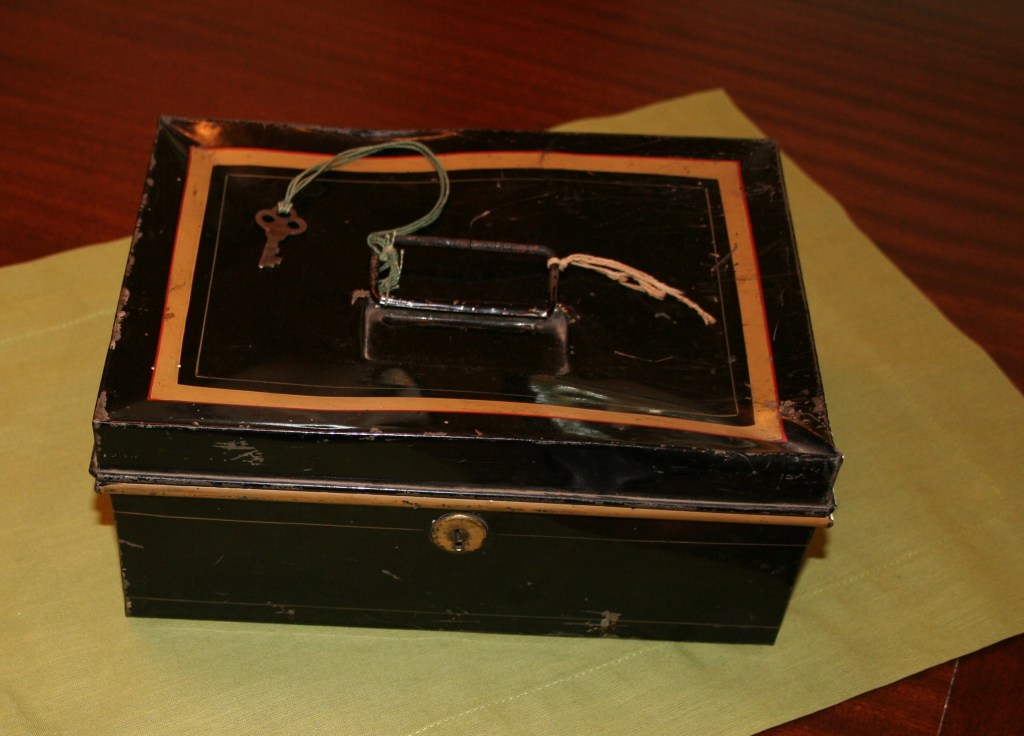
James Edward Witcher’s black box was made of tin, painted black with gold trim. His name is painted on one end as “J. E. Witcher.” It measures about ten inches by seven and a half inches, and four inches deep. The top is dented from something heavy being placed on it. It once had a sturdy wire handle, which is now inside the box, along with a key attached by a green string. The key still works in the lock on the front of the box.
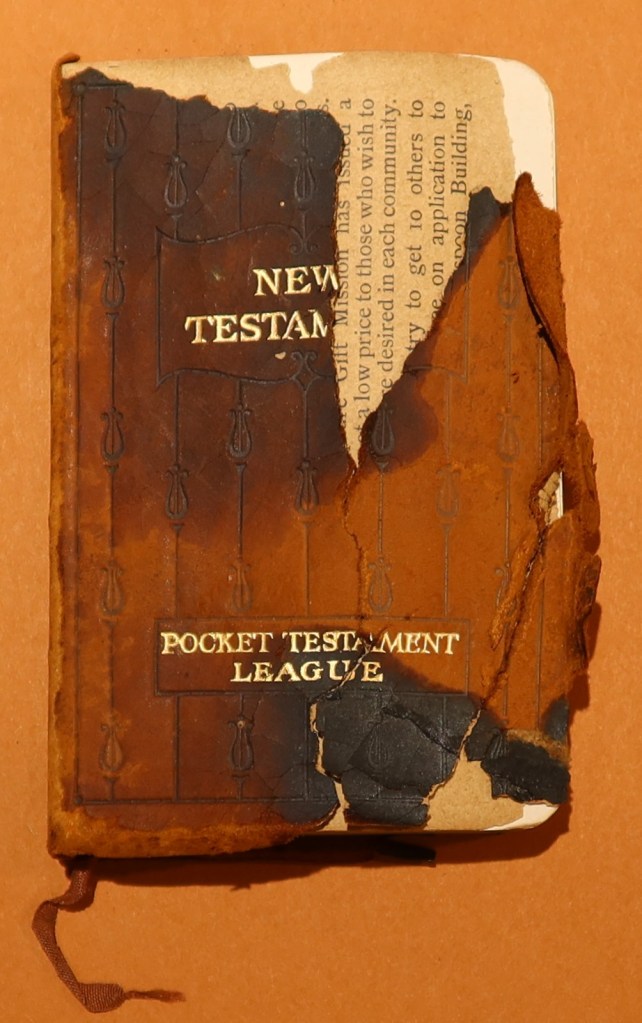
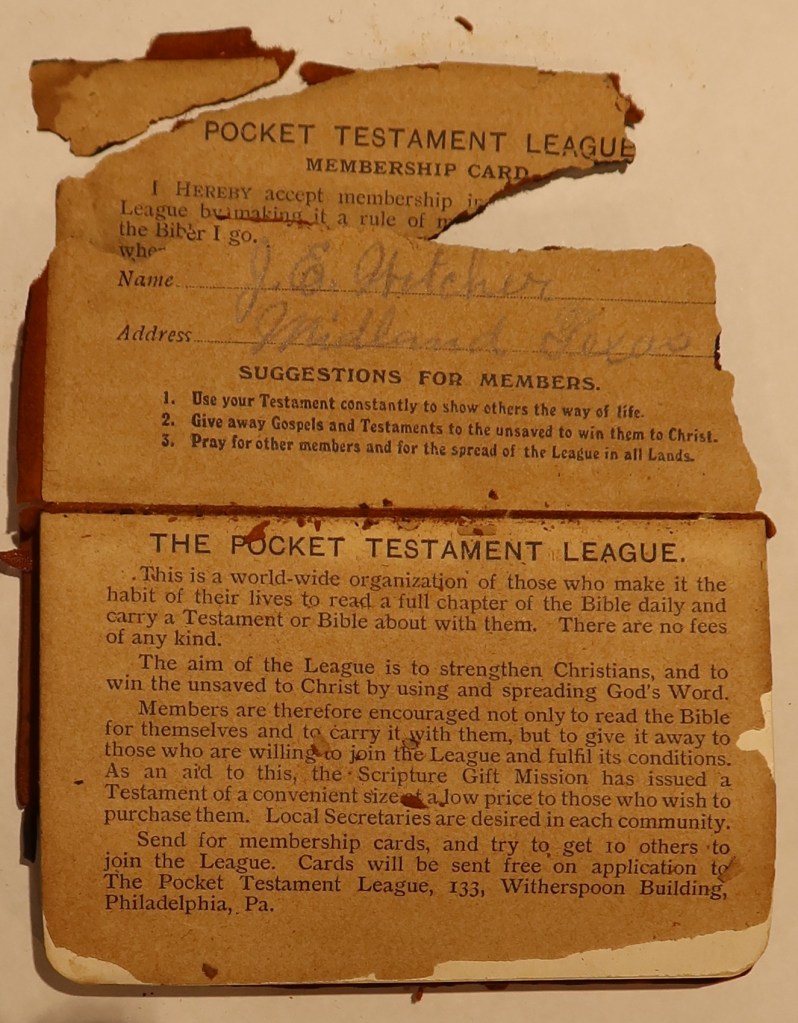
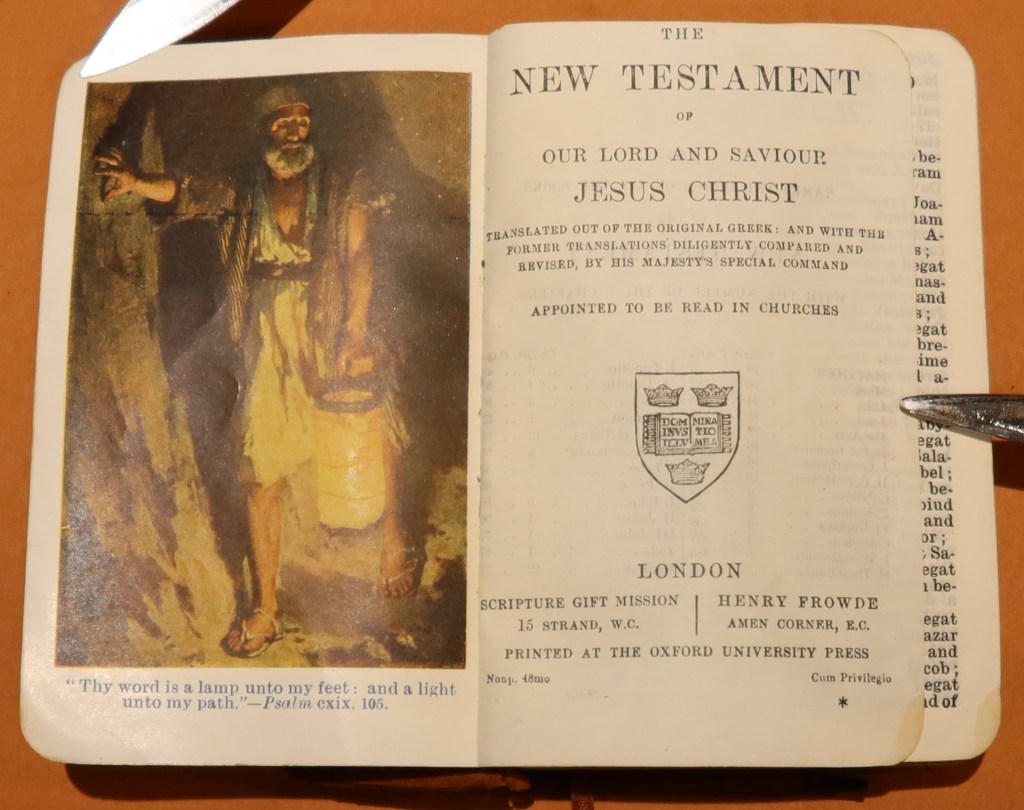
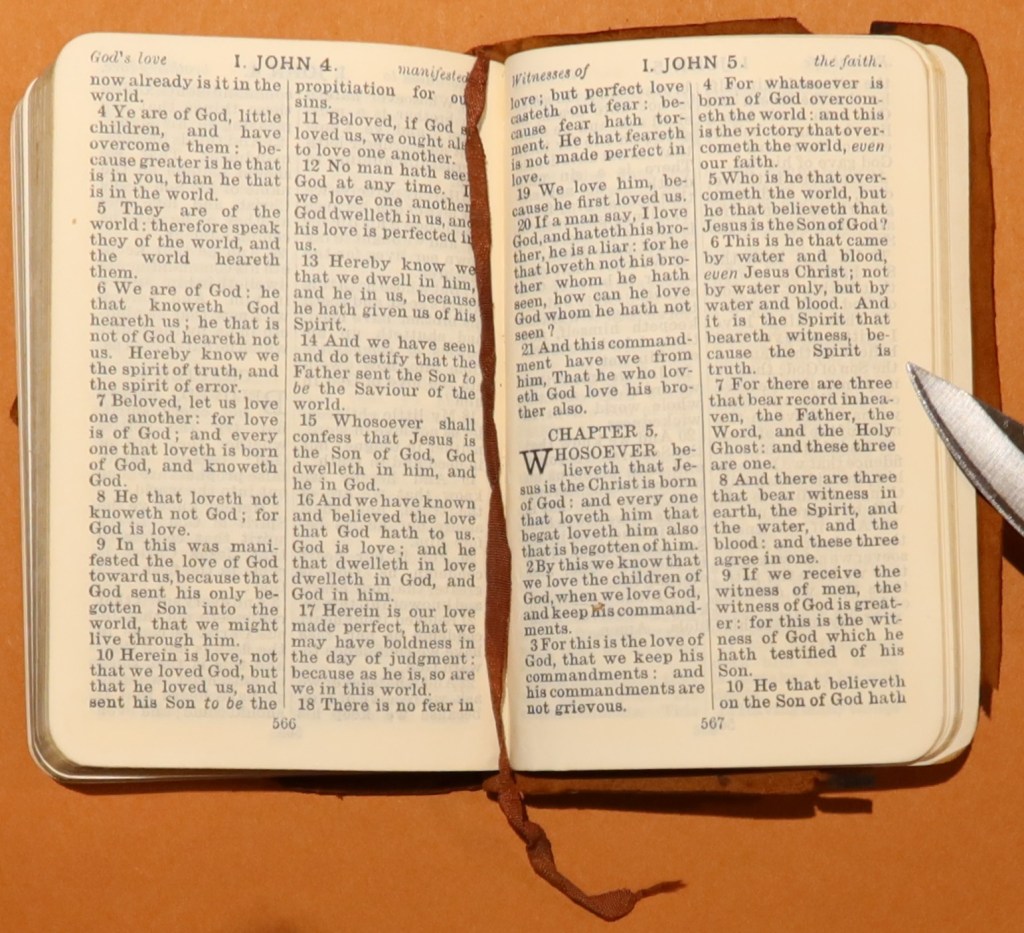
The first item in the black box is a small “New Testament Bible,” a product of the Pocket Testament League. It is in poor condition, suggesting Witcher often carried this small Bible with him. The thin leather cover, darkened in spots, has torn edges, and the front cover is in several pieces. Inside the front cover, the purpose of these small Bibles is explained, and the wrinkled ribbon may mark favorite verses. Mae was a Methodist and a member of the Methodist churches in the towns where she lived, and it is suspected that is how she and Witcher met, at church. His funeral service was held at the Methodist church in Odessa.
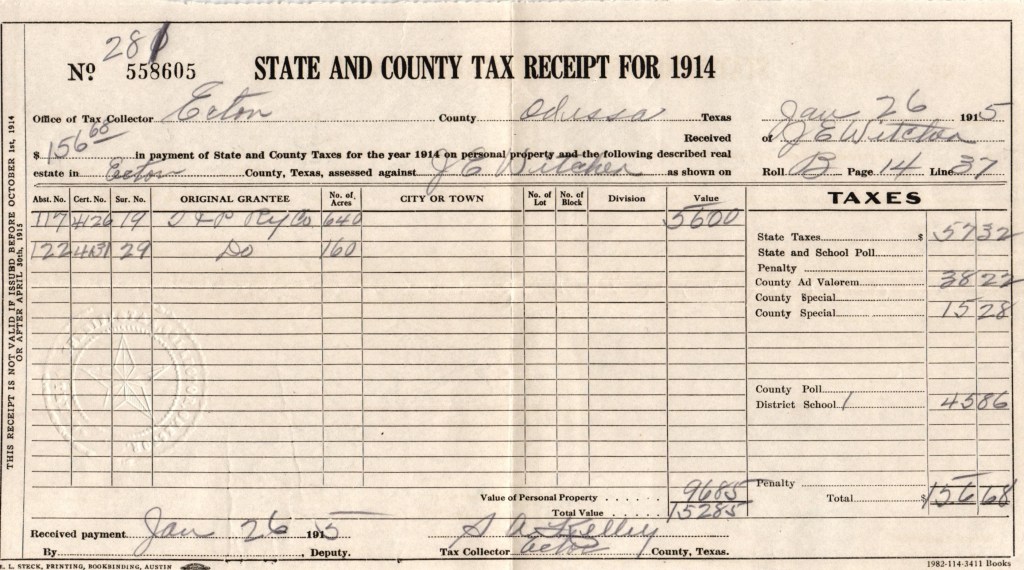
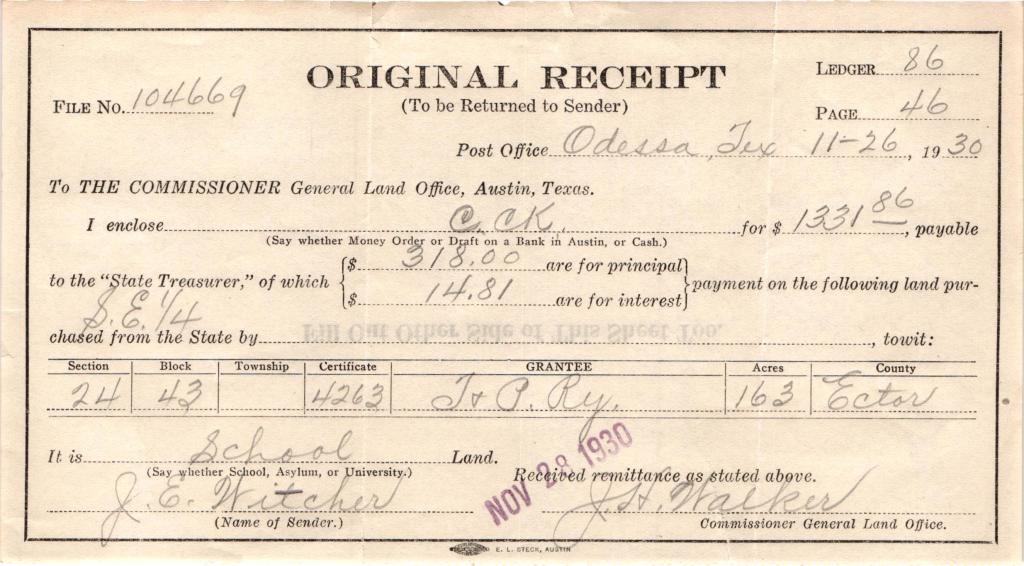
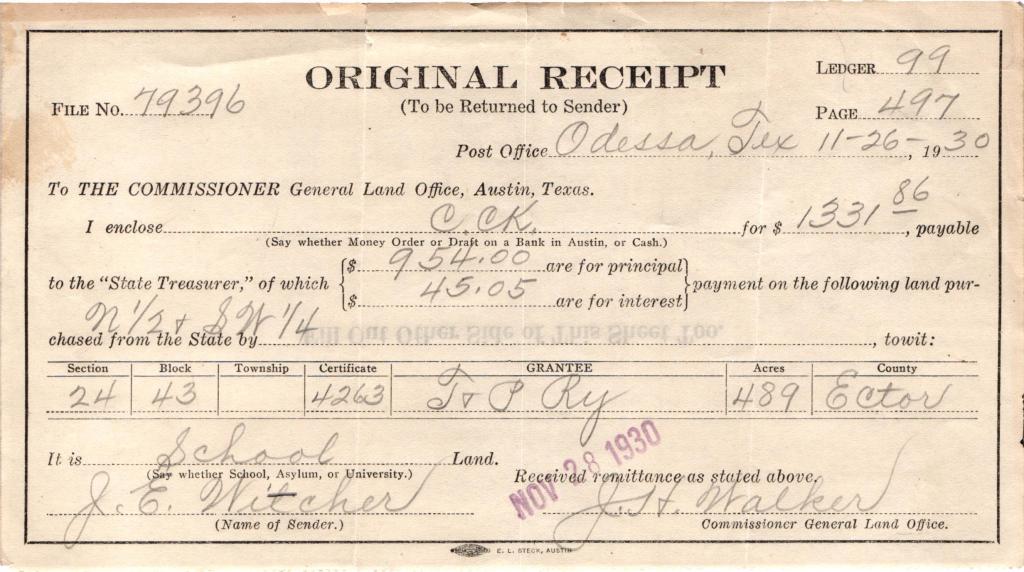
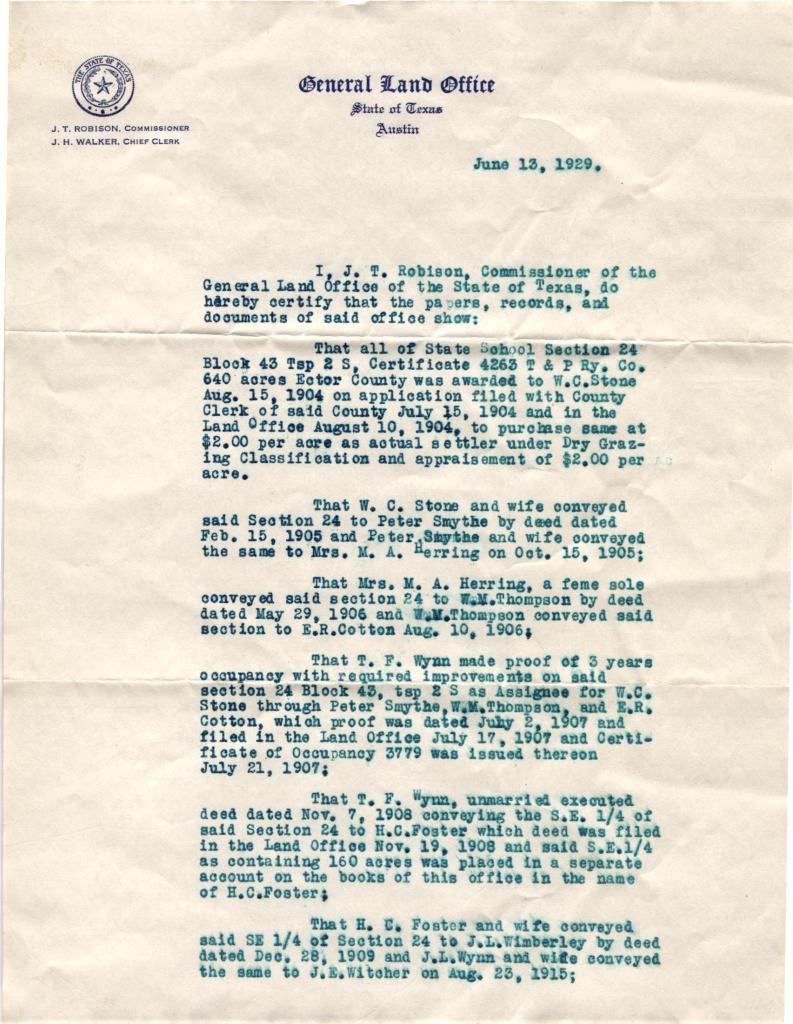
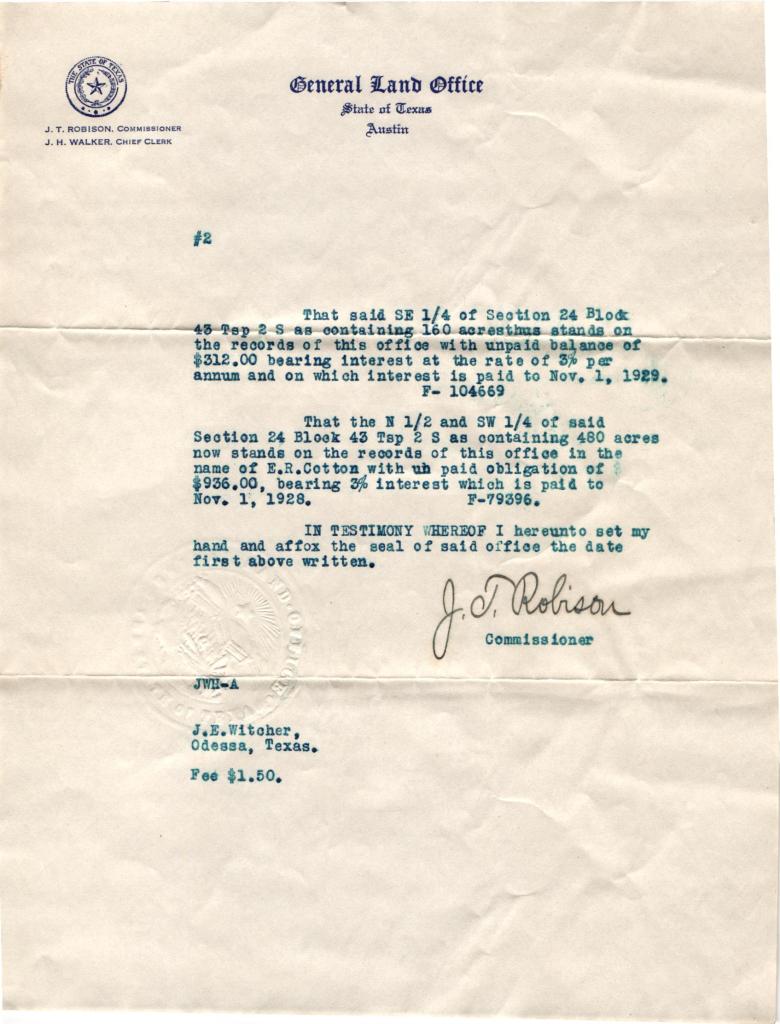
Most of the papers in the black box were Ector County tax receipts and Texas General Land Office “Original Coupon and Receipt” documents for specific land sections. Not only did Witcher pay yearly county and city taxes on town lots, but to keep his ranching acreage, he had to make at least an annual interest payment due by November 1st each year until the principal owed to the state was paid off. There were also notices and letters from the General Land Office explaining the interest payments due and providing details about the ownership history of certain land sections.
There are several Texas Motor Vehicle Certificates that show which early vehicles Witcher was driving and when. On registration receipts from 1917 through 1926, he owned a 1917 Buick D45. In 1927, Witcher registered a 1927 Ford Roadster, and just two years later, he registered both the Ford Roadster and a new 1928 Ford Coupe. The last registration receipt was in 1930, for the two Fords.

Poll tax receipts were another group of documents in the black box and were written about in a previous post on November 10, 2023, https://forwardlylooking back.com/2023/11/10/poll-tax-receipts/. This post details these receipts and how women in Texas gained the right to vote in a primary election before the 19th Amendment was passed in 1920, when Texas was predominantly Democratic.
The last set of papers in the black box consists of registration certificates for Witcher’s Hereford cattle he owned from 1919 to 1930. There are 144 certificates, mostly for cows, with just four for bulls, and most are yearlings bred and owned by Witcher or Witcher & Estes. The earliest certificates were issued to J. W. Witcher on December 22, 1919, and include 12 yearlings, and one two-year-old. The certificate for the two-year-old, shown below, indicates that the breeder is Chas. M. Dublin of Midland, Texas, while Witcher & Estes of Odessa are listed as the owners.


The next set of Hereford certificates, dated June 17, 1920, includes calves born from January through April 1920 and bred by J. E. Witcher or Witcher & Estes. J. E. Witcher is listed as the owner of all nine cows, which were bred from two bulls, Beau Donald 110th and Beau Wilton 20th. The next set of certificates, dated August 30, 1920, were originally sold to John H. Edwards of Odessa and then transferred to J. E. Witcher on February 26, 1921. The breeder and owner was W. T. Womble, of Hereford, Texas, and these calves were born in March and April 1920.
All remaining certificates dated after 1920 list J. E. Witcher as both breeder and owner. This aligns with deed records involving A. B. Estes and their purchase of 1,716 cattle with a $12,905 loan secured by Witcher’s properties in Ector County. Estes had bought a half-interest in the properties to secure the $7,000 he contributed to the deal. In 1921, Witcher produced at least 15 registered Herefords for his herd. In 1922, he added 20 registered calves. He bought a bull in October named Beau H. 200, calved in March, owned by Henry M. Halff of Midland, bred by Harry Hart of Okmulgee, Oklahoma, and sired by Watsons Disturber. Along with the bull, Witcher purchased two cows from Hardy Morgan of Lamesa. In 1923, Witcher added 32 calves. In 1924, he registered only 10 cows and one bull, Beau H. 200 Jr., calved in July, sired by Beau H. 200. In 1925, fourteen cows were registered. In 1926, Witcher registered 11 cows and two bulls. The bulls were Georgianus Jr. 63rd, calved in October and sired by Georgianus 63rd, and Beau Jamb, calved in March and sired by Beau H. 200th Jr. There are no Hereford registrations in 1927 and 1928. The last registration in 1929 was for a bull, Mischief Rex. Calved on March 8, 1929, bred and owned by Doyle Rose of Hereford, Texas, sired by Prince Axtell, and sold to J. E. Witcher on February 20, 1930.
The only information in Witcher’s documents regarding cattle sales during this period is a small, difficult-to-read scrap of paper. The listing shows four bulls sold on October 7, 1925, for $220, at $55 per head, and three bulls sold on October 12, 1925, for $165, also at $55 per head. These cattle registrations demonstrate Witcher’s pride in his herd and his desire to breed and document his high-quality Hereford cattle. The certificates he submitted for his new calves ceased in 1926, possibly indicating further signs of Witcher’s declining health.
The contents of Witcher’s black box reveal more about his personal life than most family historians can find in official documents. His small, worn Bible shows he was religious and suggests he referred to it often. The receipts indicate he was responsible for keeping up with his tax and interest payments on his land and ensuring his wife and daughter were cared for. Dying on February 20, 1931, James E. Witcher passed away without fully enjoying his accomplishments at a ripe old age of retirement, although he succeeded in cattle raising, cotton growing, and after his death, oil production—known in West Texas as the Catoico Trifecta.

 Forwardly Looking Back