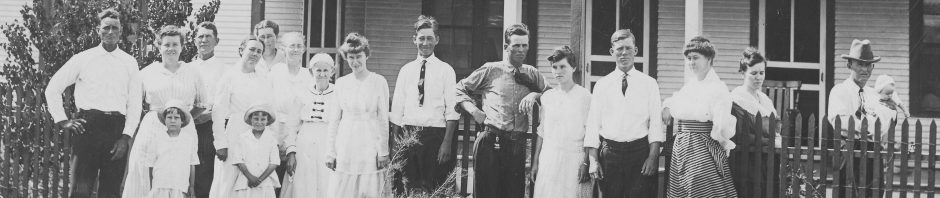
Bertha “Mae” Stickney was the fifth child born to James Franklin and Elvira Tennessee (Perry) Stickney in Jonesboro, Coryell County, Texas, on January 26, 1881. At sixteen, she moved with her parents and five younger siblings—sisters Emma Jean, Jessie Frank, Hesta Louise, Clydine Catherine, and brother Alvin Burton—to Robert Lee, Texas, in Coke County. Father James Franklin died shortly after their move. At twenty-five, Mae relocated to Roswell, New Mexico, where her eldest sister, Annie, had moved in 1905 with her husband, Cephas Brown, and daughter, Elsie. According to an article in the Roswell Daily Record dated November 2, 1906, Mae received a “Limited Scholarship” through an award proposal by the Register Tribune and the Woolverton Practical Business College. Mae studied shorthand, and other articles mention her as a student through August 1907 and her accepting a position as a stenographer at the U.S. Land Office in Kenna, New Mexico.

The Roswell Daily Record frequently reported that Mae traveled to and from Kenna, New Mexico, between February and August 1907. Kenna was booming as a major cattle shipping hub on the Atchison, Topeka, and Santa Fe Railway. Mae’s position with the U.S. Land Office likely assisted with the influx of homesteaders moving to the area, hoping to benefit from the boom. The last time Mae was mentioned in Roswell’s local newspaper was on September 30, 1907, when it reported her move to Midland, Texas.

The 1910 Census for Midland County, Texas, shows Mae was living with her cousin, Sallie Perry, whose full name was Sarah Turner Perry. Sallie, the head of this household, was 30 years old, a clerk at the Post Office, and owned her home mortgage-free. “May” is listed as a cousin, age 29, and a bookkeeper for Midland Metal Co. Sallie was the daughter of Mae’s mother’s brother, Rufus Perry. Rufus had moved his family from Jonesboro to Robert Lee, Texas, in the early 1890s, several years before Mae’s family moved there. This 1910 Census for Midland City was recorded in April of that year, and on August 7, 1910, Sallie married James Allen Florence, who was living in Midland and working as a telegraph operator for the Texas & Pacific Railway. Mae stayed in Midland through most of the next decade, working and helping to support her mother and siblings. Her youngest sister, Clydine, moved in with her to attend Midland High School from 1911 to 1915 and graduated at the top of her class. Shortly after, Mae’s mother, Elvira, went to live with Annie in Roswell, where she died on April 12, 1917.
On December 22, 1918, Mae, age 37, married James Edward Witcher, a 55-year-old rancher from Odessa. They wed in Midland, and wedding details were published in The Seminole Sentinel on January 19, 1919.
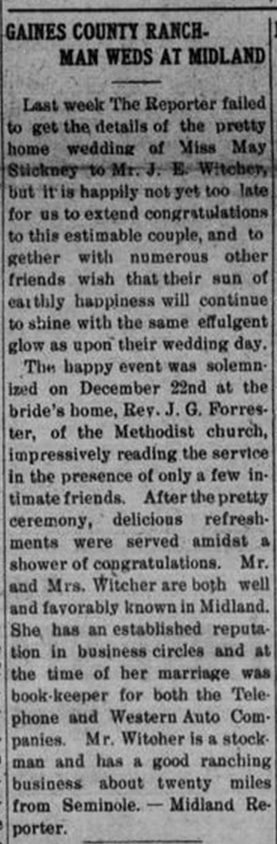
Witcher was born on November 21, 1863, in Missouri, to Hardin and Martha Frances (Ramsey) Witcher, and he grew up there. He came to Texas in the early 1890s, possibly working as a cowboy and learning the stock-raising trade, which would become his main occupation. The earliest record of Witcher in Texas is his marriage to his first wife, Mae Jones, on December 28, 1892, in Llano, Texas. Three years later, the couple is found in Elk Falls, Elk County, Kansas, where Witcher is listed as a farmer from the New Mexico Territory. Mae is listed as from Texas. Their daughter, Wanda Juanita Witcher, was born in Missouri on January 21, 1898. The following year, Witcher is back in Texas, according to the Pecos County Pickings, a Fort Stockton newspaper that states, “J. E. Witcher, who for some time has been at Hinde, Crockett County, is now receiving his mail at the Fort Stockton post office.”
The 1900 census confirms the Witchers are in Pecos County, living on a farm raising stock. The Fort Worth Record and Register newspaper on December 16, 1903, detailing the train carload lots of cattle received at the stockyards yesterday, stated J. E. Witcher of Odessa received one railroad car of 29 cows. The same newspaper on March 11, 1905, lists J. E. Witcher as among the new members of the Cattle Raiser Association of Texas.
In July 1907, Witcher moved from Pecos County to northern Winkler County, purchasing four sections of public school grazing land in Block A57, totaling 2,560 acres, for $3500. He then took advantage of the Four-Section Act of 1895, which was designed to encourage ranchers to settle in Texas’s unsettled areas. Under this law, grantees had to settle on one section for three years and make improvements to qualify to buy three more sections. In August 1907, Witcher settled on Section 1, Block A56, just west of the land previously mentioned. On September 12, 1910, he received a Certificate of Occupancy from the Texas General Land Office, supported by affidavits from three men confirming his three years of residence and improvements on the land, including the adjacent sections 2, 9, and 10, adding another 2560 acres. In December 1910, he bought four more adjoining sections, totaling 2,499 acres, from his older sister, Minerva E. (Witcher) Goodrich, for $4000. By 1912, Witcher purchased another four adjacent sections totaling 2,578 acres for $400, and in October 1912, added one more section of 640 acres for $600, bringing his total acreage to 10,837.
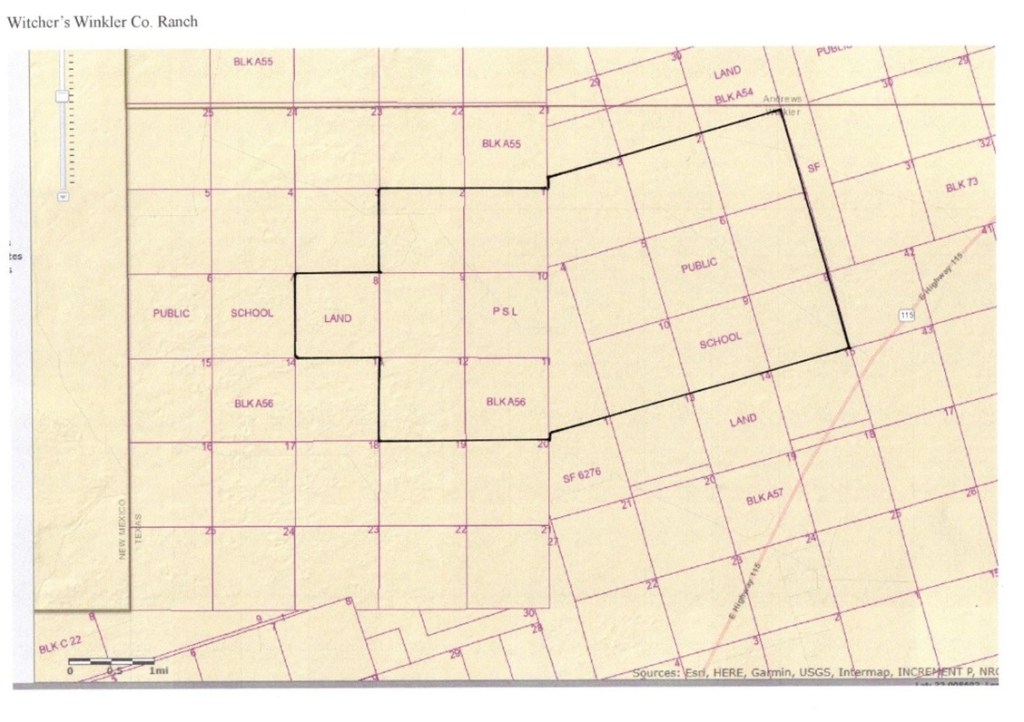
While Witcher was developing his ranch, Winkler County was just beginning to grow. In 1910, the county seat was established in Kermit. On January 12, 1911, Witcher purchased lot 3, block 45, in this new town from the Winkler County Town Company for $1.50. Two years earlier, Witcher bought a house in Odessa, Texas, for $900, located in the Original Town Lot development. His first wife, Mae, and daughter, Wanda, probably lived there instead of at the Winkler ranch. Odessa had been established in the late 1880s and offered many advantages such as an established school for Wanda to attend. Apparently, these advantages were not enough to keep Mae happy, leading her to file for divorce in Ector County and end the marriage on October 4, 1911. Witcher did not contest the divorce, nor attend the proceedings. Mae was awarded $5000, $300 a year for Wanda’s support, and the home in Odessa. An Austin Statesman, October 18, 1911, newspaper article “Cattle Receipts,” lists Witcher of Monahans selling caves and cows for about $6000, which may have been prompted by the divorce decree, giving him the ability to pay the $5000 to Mae.
In 1913, Witcher made a surprising move. On January 29, 1913, he purchased 800 acres in Ector County from the Cowden Cattle Company for $10,000. A month later, the Cowden Cattle Company bought Witcher’s Winkler County land for $17,000, which included all fencing, windmills, and, in a separate Bill of Sale, 339 head of cattle for $13,560. As a result, Witcher seemingly started all over again, expanding on this initial Ector County land shown below
On January 28, 1913, Witcher’s first purchase was for Section 19, Block 42, T2S, and the NW/4 of Section 29, Block 42, T2S. Subsequently, on August 23, 1915, the SE/4 of Section 24, Block 43, T2S, was added; on May 1, 1917, the NE/4 of Section 24, Block 43, T2S, was added; on November 12, 1917, Section 25, Block 43, T2S, was added; on May 27, 1920, the NE/4 of Section 36, Block 43, T2S, was added; and on September 29, 1922, the W/2 of Section 24, Block 43, T2S, was added. The final property was a home in Odessa, Lot 1, Block 34 of the Wright Addition, purchased on April 9, 1927.
Witcher’s move from Winkler to Ector County was probably because the land in Winkler County was School Lands, meaning any mineral interests there were used to fund Texas public schools. The land in Ector County was initially purchased from the state, which had granted land to the Texas and Pacific Railroad, and the mineral rights were included with the land.
Newspaper articles provide information about his successes in ranching and cotton farming.
The Seminole Sentinel included a small blurb in their July 4, 1918 edition, “J. E. Witcher came in the first of the week from the north plains country with a bunch of heifers he has been pasturing up there. He is bringing them to his ranch in this county [Gaines].”
The Midland Reporter on November 1, 1918, reported on ‘Cattle Shipments During the Past Week’ that – “J. E. Witcher 1 car stock cattle, Seminole to Metz.” Metz was the second railway stop after Odessa. Witcher’s land in Ector County was a few miles north of the railway tracks.
The Midland Reporter on February 4, 1921 – “J. E. Witcher and wife were in the first of the week from their Ector, County ranch. Mr. Witcher reports the range still in fine shape, though a course rain is needed.”
The Midland Reporter, dated September 4, 1925, featured a lengthy article about Witcher’s efforts in cotton growing.

Bertha Mae Stickney married Witcher in 1917, while he was in the middle of acquiring his Ector County land. Several documents refer to Witcher as “of Midland,” and it appears he conducted much of his business there, but by 1920 the US Census recorded the Witchers in Ector County on January 16, 1920. James Witcher is listed as the head of the household, owner of a mortgage-free farm, a white male, 56 years old, married, able to read and write, born in Missouri, as were his parents. He speaks English and is a farmer who owns and employs workers on this farm. “May,” for some reason, is also listed as the head of household instead of his wife; she is recorded as a white female, married, able to read and write, born in Texas, as were her parents, an English speaker, with no occupation listed.
In the last few years of the 1920s, Witcher began entering into mineral lease deals on his Ector County properties. On April 9, 1927, Witcher purchased a lot in Odessa, and two months later transferred ownership to Mae. The 1930 US Census shows that the Witchers are still in Ector County, ten miles west of Odessa. Some details, such as their given names and Mae’s parents’ places of birth are incorrect, indicating that Witcher or someone else may have provided the answers to the enumerator’s questions. “Witcher, E. James head, owns the farm they live on, age 66, was 30 years old at first marriage, born in Missouri as were his parents. Witcher, S. May, wife, age 48, was 37 years old at first marriage, born in Texas, father’s birth is US, and mother as Alabama.”
Documents from 1930 show that Witcher was in poor health. On March 3, 1930, he drafted his will. During September and October, he transferred the Mineral deeds to Mae and his daughter, Wanda Hinkle. On November 26, 1930, he paid the remaining principal owed to the state of Texas on his Ector County land. James Edward Witcher died at his home on February 20, 1931, from apparent heart issues and was buried in Odessa Cemetery. The death certificate, signed by Mae, states he had been experiencing heart problems for five years. Mae was unable to provide information about his parents, but his obituary offers more details about his family and friends.

In Witcher’s will, he bequeathed all real and personal property to his wife, “May” Witcher, and his daughter, Wanda Hinkle. He named H. E. Cummins of Ector County as his executor. Cummins submitted Witcher’s will to the court on March 31, 1931, to begin the probate process. Sheriff Reeder Webb informed the court that he had posted notices for claims against Witcher’s estate at the Ector County Courthouse in Odessa and at the post offices in Penwell and Judkin, two communities located further west of Odessa. On April 20, 1931, the witnesses to Witcher’s will, Henry Pegues and E. T. Newman, swore to its authenticity. H. C. Barrow, R. N. Henderson, and J. F. Fernandes were appointed to appraise the estate and submitted their inventory.
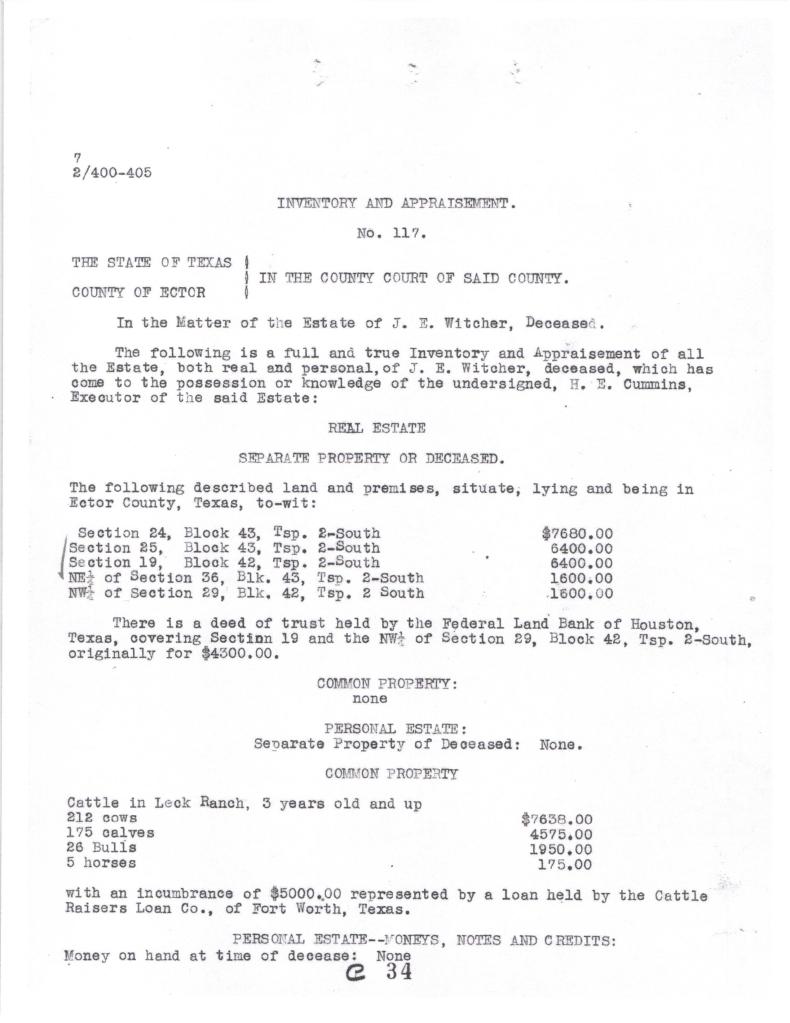

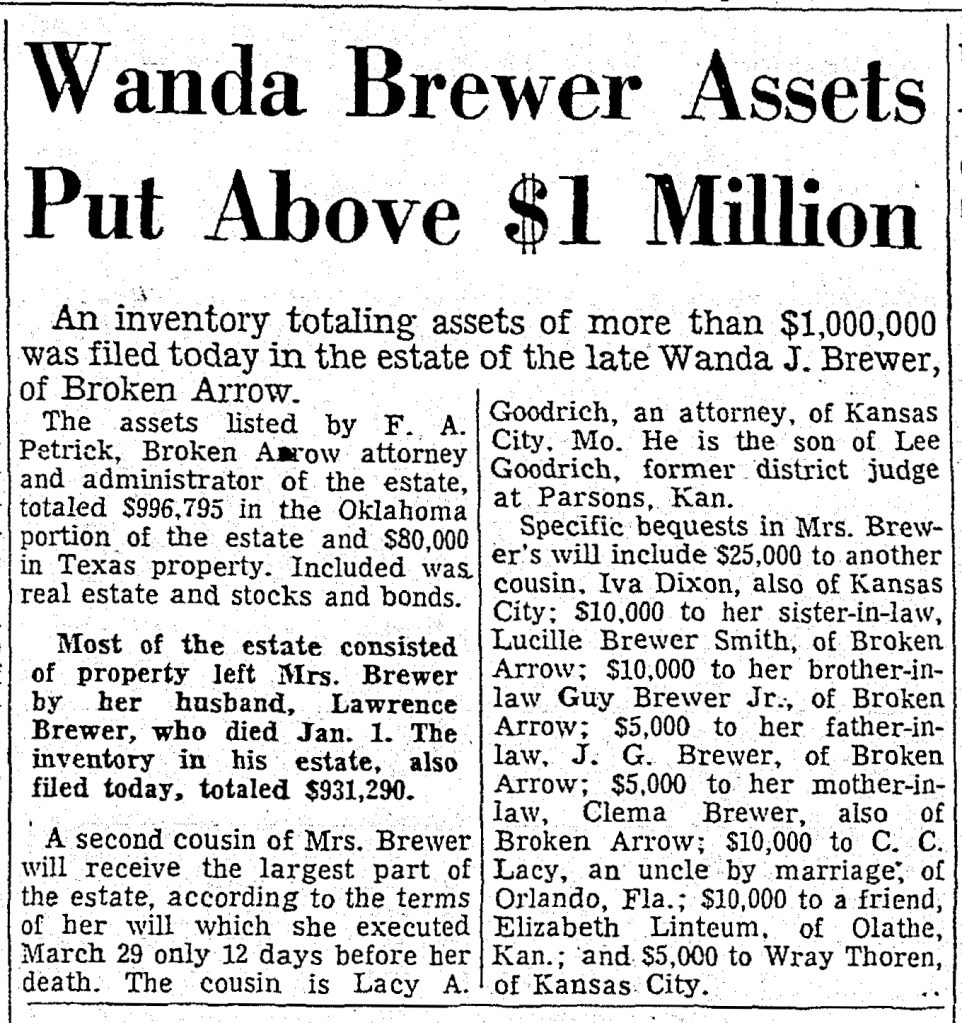
Wanda and her husband, Roy Earl Hinkle, lived in Kansas City, Missouri, and chose not to keep their share of her father’s real estate, selling it to Mae while retaining the mineral rights. Witcher did not live to see any profits from the minerals beneath his Ector County property. Mae and Wanda would come to realize these gifts fairly soon after his death. It is unlikely that Witcher played a significant role in Wanda’s childhood, but she did benefit from his presence. Strangely, neither Mae nor Wanda had children to inherit these royalties. When Wanda died in Broken Arrow, Oklahoma, her wealth surprised many, according to a newspaper article.
Mae shared her royalty wealth with her siblings, but after they all passed away, she willed the royalties to the Methodist Orphans Home, which was then located in Fort Worth, Texas. By the time her last living sibling, Clydine, died in 1989, the Methodist Orphans Home had moved to Waco, Texas. James Edward Witcher’s life work continued to benefit many people, and children still benefit today.
Part 2, J. E. Witcher’s Black Box, coming soon.

 Forwardly Looking Back